The quiff has a reputation problem. Men picture a rockabilly wave and assume it belongs in a bar, not a boardroom. The textured version is a different animal: shorter, looser, matte, and worn by half the lawyers who walk down Park Avenue at 8:30 on a Tuesday. It just looks like good hair, which is the point.
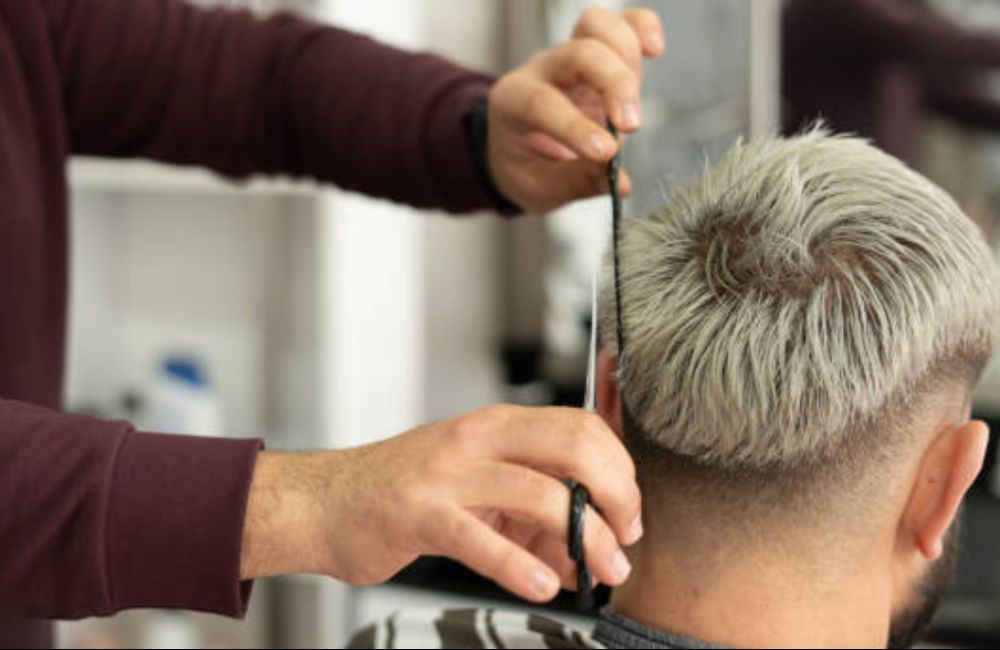
A textured quiff is a scissor cut with two to four inches on top, cut with texture so the hair separates, swept up and back from the forehead with volume at the front, over sides that are tapered or faded. It differs from a pompadour in being matte, loose and shorter rather than smooth, tall and glossy. It is $35 at Deja Vu as a classic scissor cut, takes about 30 minutes, and ends with a hot towel on the neck.
What a textured quiff is, and how it differs from a pompadour
A textured quiff is a top heavy haircut where the front is the longest point and the hair is pushed up and back from the hairline with lift. The texture comes from point cutting, which breaks the top into separate pieces so it never looks like a single helmet of hair. The sides stay short, tapered or faded, so the volume sits on top and nowhere else.
The pompadour is its older, dressier cousin. A pompadour is combed up and back as one smooth, glossy shape, usually taller, usually with a pomade, and usually with more length to work with. The quiff takes that shape and relaxes it: less height, less product, matte instead of shine, and a finger styled finish instead of a comb. From across a conference table, a pompadour says you spent time; a textured quiff says you have good hair.
| Feature | Textured quiff | Pompadour |
|---|---|---|
| Length on top | 2 to 4 inches | 3 to 6 inches |
| Finish | Matte, separated pieces | Smooth, shine |
| Height | Moderate lift at the front | Tall, sculpted |
| Tool | Fingers and a dryer | Comb, dryer and pomade |
| Styling time | 3 to 5 minutes | 5 to 10 minutes |
| Office read | Polished but relaxed | Deliberate, retro |
The quiff also gets confused with the textured crop and the slick back. The crop is short and pushed forward; the quiff is longer and pushed up and back. The slick back is combed flat to the head with shine; the quiff has lift. Our post on the textured crop covers the short forward version if that sounds closer to what you want.
Why it still reads professional
The textured quiff passes in a Midtown office because the sides stay conservative and the top looks like effortless good hair rather than a hairstyle. Keep the sides at a low taper or a low fade, keep the height moderate, keep the finish matte, and nobody on the fifteenth floor will have an opinion about it.
Three rules keep it on the right side of the line. First, the sides. A quiff over a high skin fade reads as a statement; the same quiff over a scissor taper reads as a man who gets regular haircuts. Second, the height. Two fingers of lift at the front is polished; a fist of lift is a different genre. Third, the shine. Matte clay reads as natural; a mirror finish reads as a decision. Follow all three and the textured quiff is one of the most office proof cuts we do, somewhere between the side part and the crop in formality.
It also ages well. Gray hair looks excellent in a quiff because the texture catches the light, and it survives a receding hairline longer than a slick back because the lift at the front draws the eye upward instead of to the corners. We cut it on men from 20 to 70 and the only thing that changes is the length on top. Our guide to fade haircuts after 50 covers the sides for gray and thinning hair.
Variations and combinations
The quiff is a top. The sides, the length and your hair texture produce the variations, and there are more of them than the name suggests.
By length
- Short quiff: two inches at the front, less at the crown. Lift without much sweep. Thirty seconds of dryer.
- Medium quiff: three inches, the standard. Enough to sweep back and still hold matte.
- Long quiff: four inches plus. Falls toward a loose flow by week four, which some men like. Our post on the men’s flow haircut covers where it goes next.
By the sides
- Quiff with a scissor taper: sides shortened with scissors over comb, no clipper line. The most conservative version and the one we cut as a classic scissor cut.
- Quiff with a low taper fade: skin at the sideburn and nape, sides at a 2 or 3. Office safe with a clean edge.
- Quiff with a mid fade: the blend starts at the temple. More contrast, more styling expectation. Every level is on our fade haircuts page.
- Quiff with an undercut: sides at one short length with a visible step. The boldest version and the hardest to make look professional.
By hair texture
- Straight: needs the most help from the dryer and the sea salt spray, holds the shape best once set.
- Wavy: the easiest quiff. The wave gives free volume and the point cutting just organizes it.
- Curly: becomes a curly quiff, with the curls shaped up and back rather than swept. Curl cream, no dryer.
- Thick: weight taken out of the top with thinning shears so it lifts instead of sitting.
- Fine: kept at two to three inches, cut with more texture, styled with a matte clay. Any shorter and there is nothing to lift.
Suitability by hair type and face shape
The quiff suits men with at least two inches of hair on top and medium or better density, and it flatters round, square and oval faces most. Long faces should keep the height low. Very fine hair and very short hair are the only real exclusions, and both have alternatives on the same menu.
Face shape
- Round: the quiff is the best cut you can get. Height at the front lengthens the face, and short sides narrow it.
- Square: a medium quiff with a low taper. The strong jaw and the clean sides agree.
- Oval: any version. Pick by hair texture.
- Long: short quiff with modest lift, sides left at a 3 so they do not narrow the face further. Or a crop.
- Heart: medium quiff with some weight kept at the sides to balance a narrow chin.
Hair type
Wavy and thick straight hair are the natural quiff hair types, because they supply volume the barber only has to organize. Fine straight hair can wear it at two to three inches with heavy point cutting, a sea salt spray and a matte clay, and it should avoid shine entirely. Curly hair gets the curly quiff, shaped rather than swept. Thinning crowns do better with a crop, since the quiff draws the eye to the top of the head.
Hairline
A widow’s peak is a gift for a quiff; the barber uses it as the center of the sweep. Receding corners are fine as long as the front is swept up rather than back, so the lift covers them. A very high forehead is the one case where we suggest a fringe or crop instead, because the quiff exposes the forehead by design.
How to ask your barber for a textured quiff
Say “textured quiff, about three inches at the front, shorter toward the crown, point cut, and” then the sides. “Scissor taper, no clippers” or “low taper fade, 2 on the sides” are the two usual endings. Bring a photo if you want a particular height; the words cover the rest.
- Length at the front: two, three or four inches. Say the number.
- Graduation: shorter toward the crown, so the front is the longest point and the hair sweeps back.
- Texture: point cut, or thinned if your hair is thick.
- Sides: scissor taper, low taper fade, mid fade or undercut, and the guard if clippers are involved.
- Bottom: skin or a half guard at the sideburn and nape if it is a fade.
- Neckline: tapered. A blocked neckline under a soft top looks like two haircuts.
Tell the barber how you style it. “I use a dryer” means the barber can leave a little more length. “I do not own a dryer” means the barber will cut it shorter and with more texture so it lifts on its own. The honest answer gets you the better haircut.
Styling a textured quiff step by step
Damp hair, sea salt spray, blow dry up and back, clay through the length, shape the front with your fingers. Five minutes the first week and three minutes once your hands learn it. The dryer is the step people skip and the step that does the work.
- Wash or wet, then towel dry until the hair is damp. Water should not drip when you push it back.
- Spray sea salt spray or a light volumizing spray through the top, front to crown. Fine or straight hair especially.
- Blow dry on medium heat with the nozzle pointed up and back from the hairline, lifting the front with your fingers or a vent brush. Dry the front first, then the crown. Thirty seconds to two minutes depending on length.
- Hit the front with the cool setting for ten seconds. Cool air locks the lift.
- Rub a pea of matte clay between your palms until warm, then work it through from the crown forward, lifting as you go.
- Shape the front with your fingers, pushing it up and slightly back. Pinch a few pieces apart for separation. Do not comb unless you want a smoother, more pompadour finish.
- Brush the sides down with what is left on your hands.
Wavy hair can shorten step 3 to a rough dry and skip step 4. Curly hair skips the dryer entirely: curl cream on damp hair, shaped up and back with the fingers, left to dry. Thick hair may need a stronger hold clay and a little more cool air to stay up through a humid August.
Recommended products
Two products cover the quiff: a sea salt or volumizing spray for the lift, and a matte clay for the hold. A paste replaces the clay if you want to rework the shape during the day, and a pomade replaces it if you want the smoother pompadour finish.
| Product | Finish | Hold | Role in the quiff |
|---|---|---|---|
| Sea salt spray | Matte | Light, pre styler | Grit and lift before the dryer, especially on fine or straight hair |
| Texture clay | Matte | Strong | The main hold. Separation and height that last the day |
| Molding paste | Low shine | Medium, reworkable | For men who reshape at lunch or want a softer look |
| Water based pomade | Shine | Medium to strong | Smoother, more formal finish, closer to a pompadour |
| Styling cream | Natural | Light | Longer quiffs that only need direction, and wavy hair |
| Hairspray, light | None | Finishing | Optional mist over the front for a long day or wind |
Fine hair stays matte; shine shows scalp. Thick hair can take pomade. Start with a pea, add a second pea only if the front collapses. Wash every two or three days with a clarifying shampoo once a week to clear clay buildup, and condition the ends, since three inches of hair on top will show dryness.
Maintenance and upkeep
A textured quiff needs a full cut every 4 to 6 weeks, longer than a fade because the top grows into itself rather than out of shape. The sides set the shorter end of that range: a low taper fade needs a line up around week three, a scissor taper can go the full six.
| Version | Full cut every | Between visits | Monthly cost |
|---|---|---|---|
| Quiff with scissor taper | 5 to 6 weeks | Nothing, or a $18 line up at week 3 for the neckline | $35 or less |
| Quiff with low taper fade | 4 weeks | $18 line up at day 14 to 18 | $53 |
| Quiff with mid fade | 3 weeks | $18 line up at day 10 to 12 | $53 to $70 |
Daily: the five minute routine. Weekly: one clarifying wash. Monthly: the visit. If the front starts falling into your eyes before the sides have grown, ask for a dusting of the front with your line up and the barber will take a quarter inch off in a few minutes without changing the shape. Do not trim the front yourself; the front is the whole haircut, and the scissor work there is the same craft as our classic scissor cuts.
Get a textured quiff at Deja Vu Barbershop
The textured quiff is $35 at Deja Vu as a classic scissor cut or with a fade on the sides, cut by New York State licensed barbers with 15 plus years of experience on the team, and finished with a hot towel on the neck. Add a beard trim for the Classic Combo at $48.
Deja Vu Barbershop is at 101 E 34th St between Park and Lexington in Murray Hill, two minutes from the 6 train at 33rd Street and about eight minutes from Grand Central. Hours are Monday to Friday 8am to 7pm and Sunday 10am to 5pm, closed Saturday. Walk ins are always welcome, or book online. Call (212) 576-1062 with questions.
Questions readers ask
How much hair do I need on top for a textured quiff?
At least two inches at the front. Three is the standard, four or more becomes a long quiff that sweeps rather than lifts. Shorter than two inches and the barber will suggest a textured crop instead.
Is a textured quiff hard to style?
No, but it needs a blow dryer. Sea salt spray, a minute of drying up and back, a pea of matte clay and finger shaping takes three to five minutes. Without the dryer the lift does not hold on straight hair.
Does a textured quiff work with gray hair?
Yes, very well. The texture catches light in gray hair and reads as deliberate, and the matte finish keeps it from looking sculpted. Keep the sides at a scissor taper or a low fade.
Textured quiff or textured crop for an office?
Both pass. The crop is shorter, forward and zero effort; the quiff is longer, swept up and back and needs a dryer. If you will not blow dry your hair before work, choose the crop.