Most men pick a haircut from a photo of a man with a different face. Then they wonder why it looks right on him and wrong in the bathroom mirror. The cut was fine. The face was the variable.
The haircut you should get is the one that balances your face shape: height on top for a round face, softness at the corners for a square one, weight at the sides for a long one. Three questions settle it in the chair. What is your face shape, how dense is your hair, and how much time will you give it in the morning. Answer those and the list of good cuts gets short.
First, find your face shape
Pull your hair back, look straight into a mirror, and notice three things: the widest point of your face, the length from hairline to chin compared to the width at the cheekbones, and the shape of the jaw. That gives you one of six shapes.
- Oval: slightly longer than wide, forehead a touch wider than the jaw, no sharp corners.
- Round: about as wide as it is long, soft jaw, full cheeks.
- Square: about as wide as it is long, strong jaw with visible corners.
- Oblong or rectangle: clearly longer than wide, straight sides, jaw can be soft or square.
- Diamond: widest at the cheekbones, narrower at both the forehead and the chin.
- Triangle: jaw wider than the forehead.
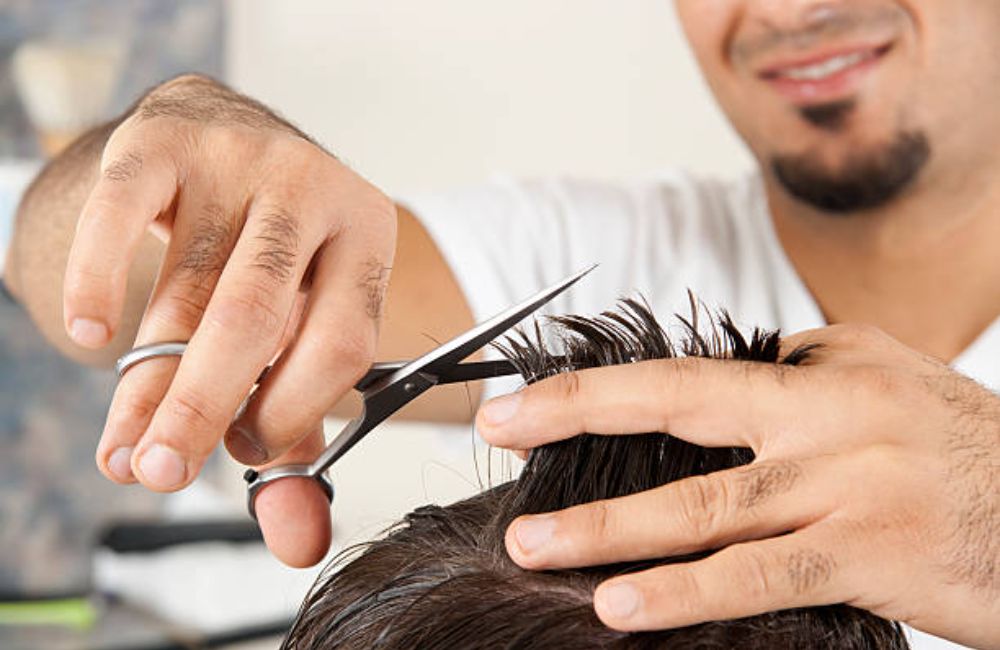
If you cannot decide between two, you are probably oval, which is the shape every cut was designed on. If you still cannot tell, ask the barber.
The cut for each face shape
The rule is balance. Add what the face is missing and take away what it has too much of. The table is the whole guide; the sections after it explain the why.
| Face shape | Get | Avoid | At Deja Vu |
|---|---|---|---|
| Oval | Almost anything; side part, quiff, crop, any fade | Heavy fringe that shortens the face | Scissor cut or fade, $35 |
| Round | Height on top, tight sides; quiff, pompadour, high fade | Round shapes, full sides, bowl cuts | Fade, $35 |
| Square | Short sides, textured top; crew cut, crop, side part | Hard geometric lines that add more corners | Scissor cut or fade, $35 |
| Oblong | Weight at the sides, less height; side part, flow, low taper | Tall quiffs, skin fades that lengthen the face | Scissor cut, $35 |
| Diamond | Fringe and some width at the temples; textured crop, side swept fringe | Very tight sides that expose the cheekbones | Scissor cut, $35 |
| Triangle | Volume on top and at the temples; quiff, longer side part | Buzz cuts and high fades that shrink the forehead | Scissor cut, $35 |
Oval
The easy one. Keep the hair off the forehead so the proportions show, and pick the cut by hair type and lifestyle instead of face. The side part on our classic scissor cuts page is where most oval faced office clients land.
Round
You need length, so build it on top. A quiff or a pompadour with a mid or high fade adds an inch or two of visual height and takes width off the sides. Keep the sides short with clippers; let the top grow. A full beard trimmed square at the jaw does the same job from below.
Square
You already have structure, so soften it. A textured crop, a crew cut with a bit of length at the front, or a side part with a low taper. Texture on top keeps the cut from adding a fourth hard edge to a face that has three.
Oblong
The opposite of round: you need width, not height. A side part with some weight left over the ears, a flow if you can grow it, a low taper instead of a high fade. Avoid tall quiffs and skin fades, which make a long face look longer.
Diamond
Width at the top and bottom, softness at the cheekbones. A textured crop with a forward fringe fills the forehead; a bit of length over the ears fills the jaw. Very tight sides are the mistake, because they make the cheekbones the widest thing in the picture.
Triangle
A wider jaw wants a wider top. A quiff or a longer side part with volume at the temples balances it. A buzz cut or a high fade shrinks the top of the head and makes the jaw look heavier than it is.
How dense is your hair?
Density decides whether the cut on the table is achievable. Thick hair can hold height without product; fine hair cannot, and thinning hair should not try.
Thick, dense hair: anything with height is on the menu, and the sides should be faded or tapered so the volume on top does not read as volume everywhere. Fine hair: shorter and more textured, because texture reads as density and length reads as flat. A crop or a crew cut with a bit of matte paste looks fuller than a side part that lies down. Thinning hair: shorter still, kept short enough that the scalp does not show through length, and a face shape that wants height has to get it from a shorter, more textured top rather than a tall one. Our guide to the textured quiff covers the version of height that works on medium density hair. For gray coming in, see our guide to gray blending at the barbershop.
How much maintenance will you really do?
Be honest, because the cut will find out. There are two costs: minutes in the morning, and visits to the chair.
- Zero minutes, visit every 3 to 4 weeks: buzz cut, crew cut, low taper. Towel and go.
- Thirty seconds, every 3 to 4 weeks: textured crop, short side part. One product, no dryer.
- Two to five minutes, every 2 to 3 weeks: quiff, pompadour, slick back, any skin fade. Dryer, comb, product.
- Grow out, trim every 8 to 12 weeks: flow, longer side part. Patience, then almost nothing.
A round face that wants a tall quiff and a man who will not touch a dryer are in conflict, and the dryer wins every morning. The fix is a shorter version of the same idea: a crew cut with length at the front over a high fade still adds height and takes thirty seconds. The schedule for each is in how often to get a haircut.
Texture matters as much as shape
Straight, wavy and curly hair do different things with the same cut, so the table above shifts a step for each.
Straight hair shows every line, holds height well when dense, and lies flat when fine. It takes the sharpest fades and the cleanest side parts. Wavy hair adds volume on its own, which is a gift to oblong and triangle faces and a problem for round ones unless the sides are kept tight. Curly hair carries its own shape; the barber cuts the outline, square or round, to balance the face, and the curl does the rest.
How to bring all of this to the chair
Say your face shape if you know it, your morning budget in minutes, and what you do for a living. A barber can build a cut from those three facts faster than from a photo. If you bring a photo, bring one of a man with your hair type and roughly your face, and say which part of it you like: the sides, the top, or the whole thing. Choosing for a son? Our guide to a kid’s first haircut covers the youngest clients.
Then let the barber push back. The no upselling rule at Deja Vu cuts both ways: nobody will sell you a longer ticket, and nobody will cut a shape that will not work on your head just because you asked. Every haircut is $35 either way, scissor or clipper, and it ends with a hot towel on the neck.
Find your cut at Deja Vu Barbershop
Deja Vu Barbershop is at 101 E 34th St between Park and Lexington in Murray Hill, two minutes from the 6 train at 33rd Street and about eight from Grand Central. Every barber is New York State licensed with more than fifteen years of experience on the team, and face shape is the first thing they look at before the clippers come out. A classic scissor cut or a fade is $35.
Hours are Monday to Friday 8am to 7pm and Sunday 10am to 5pm, closed Saturday. Walk ins are always welcome, or book online and call (212) 576-1062 with questions.
Questions readers ask
What haircut makes a round face look slimmer?
Height on top and tight sides. A quiff or pompadour over a mid or high fade adds visual length and takes width off the cheeks. Avoid full sides and anything rounded.
What haircut suits a long face?
Weight at the sides and less height on top: a side part with some length over the ears, a flow, or a low taper. Skip tall quiffs and skin fades, which make the face longer.
Does face shape matter if my hair is thinning?
Less than density does. Keep it short and textured so the scalp does not show through length, then balance the face with the sides: tighter for round, a little weight for oblong.
Can the barber tell me my face shape?
Yes, and it is the fastest way to find out. Say you are not sure and ask which cuts balance it; a licensed barber sees dozens of faces a week and will have an answer in seconds.