Every man who grows his hair out hits the same wall around week eight: too long to be short, too short to be long, sticking out over the ears like a helmet. Most give up there and ask for a fade. The ones who make it to the flow are the ones who kept coming in for haircuts while they grew it, which sounds backwards and is the entire secret.
A flow haircut is medium length hair, usually four to eight inches on top and over the ears, cut in soft layers so it sweeps back and to the sides with natural movement rather than structure. You get there without an awkward phase by having the sides shaped every four to six weeks while the top grows untouched. Each shaping visit is a $35 classic scissor cut at Deja Vu, about 30 minutes, hot towel on the neck included.
What a flow haircut is, and why it is the medium length standard now
A flow is defined by movement rather than shape. The hair is long enough to push back off the face and over the ears, layered so it falls in loose pieces instead of a single curtain, and left to do what it wants after a rough dry. There is no part to maintain and no product to sculpt with.
It has become the default medium length cut for men because it fits the way offices dress now. A blazer over a tee, a flow pushed back, a kept beard. It is the look of half the people in tech and media in Midtown South and a growing number on the conservative floors around Park Avenue, where it reads as relaxed confidence as long as it is clearly cut and clean. The pompadour and the undercut dated themselves; the flow does not, because it is barely a style. Neither do the classic men’s haircuts that never date. It is just hair, kept well.
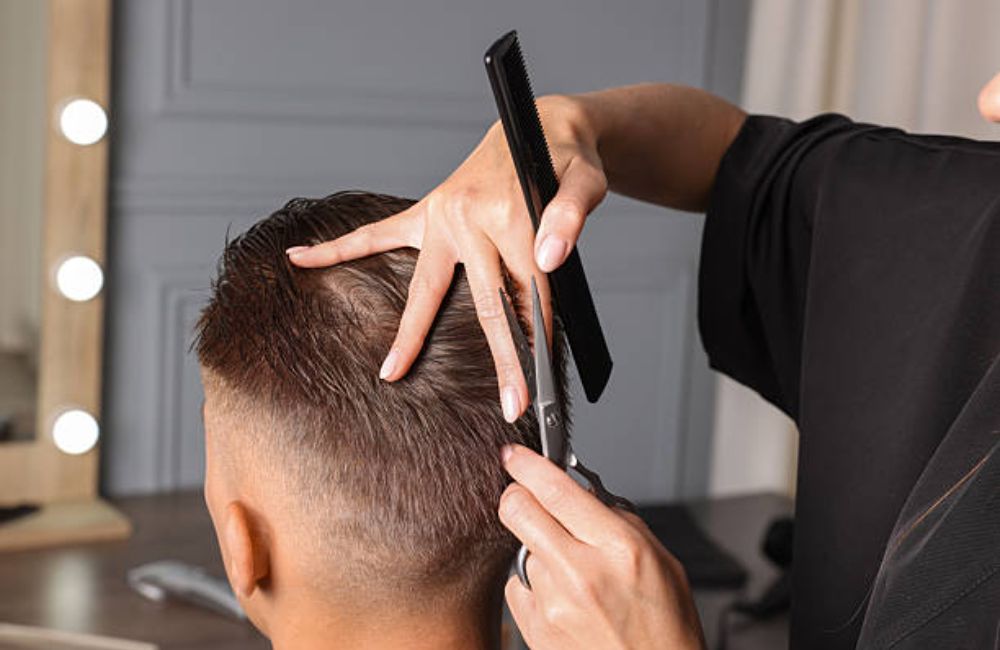
The lengths that matter: around four inches on top is the earliest a flow starts to flow, six inches is the classic version that tucks behind the ears, and eight or more is a long flow that sits on the collar. The sides and back are usually one to two inches shorter than the top so the whole thing moves back instead of out.
Growing it out without the awkward phase
The awkward phase is the sides and back catching up to the top. You skip it by keeping the sides and back shaped and slightly shorter the whole way, so the hair always looks intentional, while the top is never cut. Hair grows about half an inch a month, so a flow from a short cut takes eight to twelve months, and every one of those months can look like a haircut rather than a mistake.
- Month 0 to 1, from a short cut. Let everything grow. Nothing to do yet except stop using clippers. If you had a fade, the sides will grow in blotchy around week three; a $18 line up on the neckline and sideburns keeps it tidy.
- Month 2. First shaping visit. The barber cleans the neckline, takes the bulk out of the sides with scissors over comb, and leaves the top alone. This is the visit most men skip, and it is the one that prevents the helmet.
- Month 3 to 4. Two to three inches on top. The hair starts to sit over the ears. Second shaping: sides thinned and tapered to the neck, back shaped so it does not mushroom, top still untouched. Start pushing the top back after the shower.
- Month 5 to 6. Four inches. This is where the flow begins. Third visit: the barber adds the first soft layers on top so it moves instead of flopping, dusts the ends, and keeps shaping the sides. You can tuck behind the ears from here.
- Month 7 to 9. Five to six inches. The classic flow. Every visit from here is a trim: layers refreshed, ends dusted a quarter inch, sides and back shaped. The top stays the same length or grows slowly, your call.
- Month 10 to 12. Six to eight inches if you keep going. The long flow. Same maintenance, and the beard starts to matter more because the hair frames the face from both directions.
Two things to avoid. Do not get a fade halfway through; it resets the sides to zero and the awkward phase comes back. And do not let a barber “clean it up” with a guard on the sides. The order is “shape the sides with scissors, do not cut the top,” every visit, for a year. Our post on how often you should get a haircut has the schedule for the whole menu if you want the context.
Flow variations
The flow has a family. The differences are length, the amount of layering, and what happens at the sides and in the beard.
Classic flow
Five to six inches, layered, pushed back, tucked behind the ears. Sides shaped with scissors, not faded.
Bro flow
The same cut with less effort: a little longer, a little messier, air dried, often with a beard. The weekend version of the classic.
Hockey flow
Longer at the back, six to eight inches, with the ends curling out at the collar or from under a cap. More mullet in spirit than the classic.
Middle part flow
The hair falls to either side of a center part instead of being pushed back. Needs six inches and straight or wavy hair that will sit flat at the crown.
Wavy and curly flow
Same lengths, but the layers are cut to let the wave or curl stack rather than fall. The easiest flow to grow because the texture hides the awkward phase on its own.
Flow with a fade or undercut
Length on top with faded or undercut sides. Technically not a flow by the strict definition, since the sides do not flow, but it is popular with men who want the movement up top and the clean edge below. The sides are cut as one of our fade haircuts.
Flow with a beard
Any of the above with a beard shaped to match the hair’s weight. A full flow over a thin beard looks top heavy; a short flow over a big beard looks bottom heavy. Our beard trim and grooming service balances the two, and fade or cut plus beard is the Classic Combo at $48.
Choosing a flow by hair type and face shape
Wavy hair is the natural flow hair, straight hair needs layers and a little product, and curly hair gets a curly flow that is really its own cut. Face shape decides whether you push it back, part it, or keep it shorter. Our guide on which haircut suits your face shape covers the same question for every cut.
Hair type
- Wavy: the easiest. Layers organize the wave and the wave does the rest.
- Straight: needs more layering so it does not hang like a curtain, and a cream or sea salt spray for body. Pushed back works better than a middle part on fine straight hair.
- Curly: a curly flow, cut to let the curls stack. Curl cream, no dryer.
- Thick: weight taken out with thinning shears at every visit or it mushrooms over the ears.
- Fine or thinning: keep the flow short, four to five inches, with layers for lift. If the crown is thinning, a shorter cut will honestly look better, and we will say so. Our guide to fades for thinning and gray hair covers that route.
Face shape
- Oval: any version.
- Round: pushed back with height at the front; avoid the middle part, which widens the face.
- Square: classic flow, pushed back, with a little length over the ears to soften the jaw.
- Long: middle part or a shorter flow with less height. Keep the sides a little fuller.
- Receding hairline: pushed back exposes the corners; a flow swept forward and to the side, or a shorter flow with a fringe, covers them.
How to ask your barber for a flow
Say “I am growing it into a flow. Do not cut the length on top. Shape the sides and back with scissors so it lies down, taper the neckline, and take some weight out.” Once the top reaches four inches, add “put some soft layers in so it moves.” That is the complete order at every stage.
- Stage: say whether you are growing it or maintaining it. The barber cuts differently for each.
- Top: do not cut the length, or dust the ends a quarter inch if you are maintaining.
- Layers: soft, long layers. Not short layers, which make a flow look like a shag.
- Sides and back: shaped with scissors over comb, one to two inches shorter than the top, no guards.
- Weight: thinned if your hair is thick.
- Neckline: tapered, never blocked.
Bring a photo of the finished flow you want, and tell the barber how long you have been growing. A barber who knows you are at month three will leave the top alone and spend the whole 30 minutes on the sides, which is exactly right. Every shaping visit is cut the way our classic scissor cuts are, scissors over comb and no clipper line.
Styling a flow
Towel dry, push it back with your fingers, a small amount of cream or sea salt spray, and let it air dry or rough dry it back with a dryer on low. Three minutes. A flow that needs more than that was cut as something else.
- Wash with a light shampoo every two or three days; condition every time you wet it, since medium length ends dry out.
- Towel dry gently until damp. Rubbing hard roughens the ends and makes a flow frizz.
- Rake a fingertip of styling cream through from the roots back, or mist sea salt spray through the length for a grittier, beachy finish.
- Push everything back and to the sides with your fingers. Tuck behind the ears if it reaches.
- Air dry, or rough dry with a dryer on low heat pointed back from the hairline, lifting the front with your fingers for height.
- Once dry, push it back once more and leave it alone. Touching it through the day flattens the movement.
Straight hair benefits from the dryer step for volume at the front. Wavy hair can skip it. Curly hair uses a curl cream and no dryer at all. If the flow falls into your face by noon, the layers are too short or the product is too heavy; mention it at the next visit.
Products for a flow
A styling cream and a sea salt spray cover almost every flow. Clay and pomade are too heavy for medium length hair and kill the movement. A good conditioner matters more than any styling product, because six inches of hair shows damage that one inch never did.
| Product | Finish | Hold | Role in the flow |
|---|---|---|---|
| Styling cream | Natural | Light | The daily product. Direction and softness without stiffness |
| Sea salt spray | Matte, textured | Light | Body and grit on straight or fine hair; the beachy version |
| Texturizing spray | Matte | Light to medium | Volume at the roots for a pushed back flow |
| Leave in conditioner | Natural | None | Ends over four inches, especially wavy and curly hair |
| Curl cream | Natural | Light | Curly flow, on damp hair, left alone |
| Light pomade | Slight shine | Medium | Only for a slicked back, more formal flow on a thick head of hair |
Quantity stays small: a fingertip of cream, a few sprays of salt. Clarify once a week with a stronger shampoo to clear buildup, and trim the ends every six weeks or the length you spent a year growing will split and look thin.
Maintaining a flow
A flow is trimmed every 4 to 6 weeks, sides shaped and ends dusted, and the top is otherwise left alone. It is cheaper to maintain than a fade because the visits are further apart, and the daily routine is a three minute push back.
| Stage | Visit every | What the barber does | Cost |
|---|---|---|---|
| Growing (months 1 to 6) | 4 to 6 weeks | Shape sides and back, taper neckline, thin if thick, no length off the top | $35 |
| Maintaining (month 7 on) | 5 to 6 weeks | Dust ends a quarter inch, refresh layers, shape sides | $35 |
| Neckline only | Between visits if needed | Line up and edge up, about 15 minutes | $18 |
| Flow plus beard | 4 to 6 weeks | Cut and beard shaped together | $48 Classic Combo |
Between visits, condition every wash, sleep on the hair dry rather than wet, and keep hats loose. Do not trim your own layers or your own sideburns; a flow is forgiving of growth and unforgiving of a crooked cut. And when you decide you are done with it, we take it down to any cut on the menu in a single $35 visit.
Grow it out at Deja Vu Barbershop
Every shaping visit on the way to a flow is a $35 classic scissor cut at Deja Vu, done by New York State licensed barbers with 15 plus years of experience on the team, with a hot towel on the neck at the end. Pair it with a beard for the Classic Combo at $48.
Deja Vu Barbershop is at 101 E 34th St between Park and Lexington in Murray Hill, two minutes from the 6 train at 33rd Street and about eight minutes from Grand Central. Hours are Monday to Friday 8am to 7pm and Sunday 10am to 5pm, closed Saturday. Walk ins are always welcome, or book online. Call (212) 576-1062 with questions.
Questions readers ask
How long does it take to grow a flow haircut?
About eight to twelve months from a short cut, since hair grows roughly half an inch a month and a flow starts at four inches on top. Shaping visits every four to six weeks keep it looking intentional the whole way.
Should I stop getting haircuts while growing a flow?
No. Keep coming every four to six weeks for the sides and back to be shaped with scissors while the top is left alone. That is what prevents the awkward phase.
Does a flow work with straight hair?
Yes, with long soft layers and a styling cream or sea salt spray for body. Straight hair flows best pushed back with a little height at the front rather than parted in the middle.
Can a flow look professional in an office?
Yes, if it is clearly cut and clean: shaped sides, a tapered neckline, conditioned ends and no product shine. A flow pushed back over a blazer is one of the most common looks in Midtown now.