Fade is one word that covers at least eight haircuts. The man asking for a fade at 8am before a meeting on Park Avenue and the man asking for one on Sunday afternoon before a date are often picturing two completely different heads, and both of them are right. The difference is where the shortest point sits and how far up the side the blend climbs.
The main types of fade haircut are the low, mid and high fade, named for how high the blend starts; the skin fade, where the bottom is bare; the drop fade and burst fade, named for the shape of the line; the temple fade, which only touches the temples; and the taper fade, the smallest version. All of them are $35 at Deja Vu with a hot towel neck finish, and all of them are cut in about 30 minutes.
The eight types of fade, and who each one suits
Every fade is a gradient from short to long. The names only tell you two things: where the shortest hair sits on the head, and what shape the line of that gradient takes. Here are the eight you will hear in our shop, from the most conservative to the loudest.
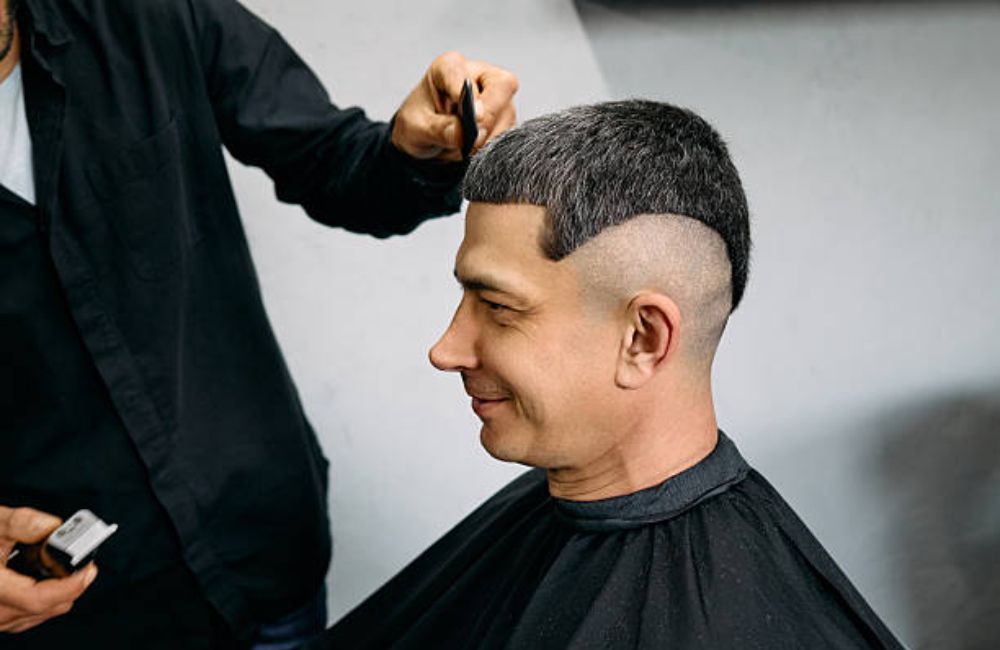
Low fade
The blend begins about an inch above the ear and finishes before the temple. From the front you mostly see hair. It suits men who want a clean edge without a visible gradient, fine hair that would show scalp higher up, and anyone in a conservative office. It is also the one that grows out most gracefully. For a boy’s first fade, see our guide to matching father and son cuts.
Mid fade
The shortest point sits at the temple and the blend ends around the middle of the side of the head. It is the most requested fade in the shop because it has real contrast but still reads as a grown man’s haircut in a suit. It suits almost every face shape and every hair texture, which is why it is the default recommendation when a client says “just a fade.”
High fade
The blend runs up to the parietal ridge, the shelf where the side of the head curves into the top, so most of the side is very short. It suits a round face that needs height, thick hair that needs its bulk removed, and men who style the top every morning. It is the highest maintenance of the three levels.
Skin fade (bald fade)
Any level of fade where the bottom is taken to bare skin with a foil shaver or straight razor. Skin fade and bald fade are the same cut; the name changes by neighborhood, not by technique. A low skin fade is still an office cut. A high skin fade is a statement. It suits men with dense hair and a clean hairline, and it looks sharpest on darker hair where the contrast shows.
Drop fade
The fade line dips behind the ear and follows the curve of the skull down toward the nape instead of running straight around. It suits round heads, longer tops that sweep back, and anyone who felt a straight fade line made the back of their head look flat.
Burst fade
A half circle of short hair around the ear that leaves the neckline long. It is built for mohawks, curly tops and mullets. It does not suit a Midtown dress code, and we will say so if you ask.
Temple fade
Only the temples and the corners of the hairline are faded, with the rest of the sides left at one length. It suits men who keep their sides at a 2 or longer and only want the hairline corners sharp, and it is popular with our line up clients because it refreshes in about 15 minutes.
Taper fade
The smallest fade, kept close to the sideburn and neckline. It suits anyone who wants the clean bottom edge of a fade with the grow out of a taper, and it is the safest first fade for a man coming off a scissor cut. The full comparison is in our post on taper vs fade.
Popular combinations: what goes on top
A fade only describes the sides. The cut you actually wear is the fade plus whatever you keep on top, and the top is where the style lives. These are the pairings we cut most on East 34th Street right now.
Fade with a textured crop
Short, choppy length on top pushed forward into a blunt fringe, usually over a mid or low skin fade. It hides a receding corner, needs almost no styling, and is the most popular combination among our clients under 40. Our guide to the low taper with a textured fringe covers the softer version.
Fade with a quiff or pompadour
Two to four inches on top swept up and back, over a mid or high fade. The quiff is textured and loose; the pompadour is smooth and tall. Both need a blow dryer and a product with hold, so they belong to the man who spends five minutes on his hair.
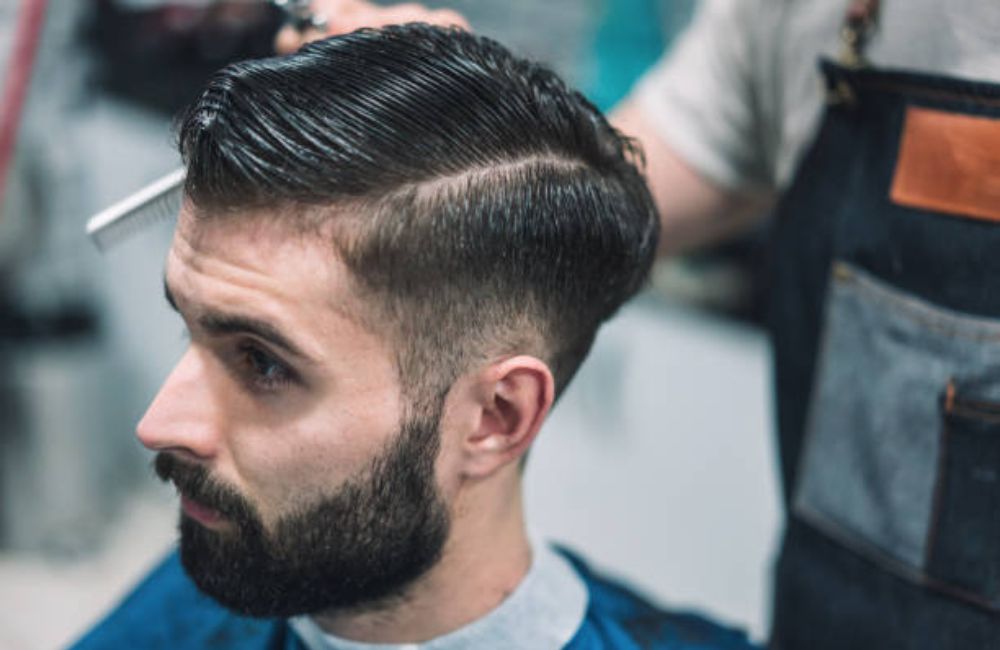
Fade with a side part
A low or mid fade with a hard part shaved in or a natural part combed in, and the top combed over. The most office proof combination on the list. It works with gray hair, fine hair and every suit in Midtown.
Fade with a comb over or slick back
Longer top combed straight back or diagonally over a low fade. It needs a pomade or cream and a comb, and it reads as the classic businessman cut when the fade stays low.
Fade with a buzz cut or crew cut
A number 2 or 3 on top with a skin or low fade on the sides. Zero styling, two week upkeep, and the hairline matters more than anywhere else because there is nothing to distract from it.
Fade with curly or coily hair
Curls on top, often two to three inches, over a mid skin fade or a drop fade. The gradient against the texture is the cleanest contrast in barbering. Pair it with a line up and the whole thing looks finished.
Fade with a beard
Any fade with the sideburn blended straight into the beard so there is no step between hair and face. The blend takes an extra few minutes and is the whole point of our beard trim and grooming service. Fade plus beard is the Classic Combo at $48.
Choosing by hair type, face shape and hairline
Pick the level by your hair density first, the face shape second, and the hairline third. The barber will weigh all three in about ten seconds, but it helps to know why the recommendation lands where it does.
Hair type
- Thick, straight hair: any fade works. A mid or high fade removes the bulk that makes the sides puff out.
- Fine or thinning hair: low fade or taper fade. A high fade exposes the scalp and makes the top look thinner by comparison.
- Wavy hair: low or mid fade, with a drop at the back if the waves sit heavy there.
- Curly and coily hair: mid skin fade or drop fade. The texture up top makes the gradient look sharper.
- Gray or salt and pepper hair: keep the fade low or mid. Gray shows less contrast against skin, so a high skin fade can look washed out. Our guide to fades for gray or thinning hair goes further.
Face shape
- Round: mid or high fade to add height and narrow the sides.
- Long or oval: low fade so the face is not stretched further.
- Square: anything; a drop fade softens the corners.
- Heart or narrow chin: low fade with some weight left on the sides to balance the jaw.
Hairline
A receding corner is the reason to pick a textured crop or a fringe over a slick back, because forward length covers the corner. A widow’s peak suits a quiff that uses the peak as its center. A cowlick at the crown is handled with length, so do not go to a 1 across the whole crown if you have one. A full guide to the levels alone is on our page on which fade haircut is right for you.
How to ask your barber for a fade
Say the level, the bottom, the top and the line in that order, and bring a photo if you have one. “Mid fade, skin at the bottom, leave the top long, natural neckline” is a complete order that any licensed barber can cut without a second question.
The four parts of a fade order
- Level: low, mid or high. This is where the shortest point sits.
- Bottom: skin, or a guard number. 0 is a bare blade, 1 is an eighth of an inch, 2 is a quarter inch, 3 is three eighths, 4 is half an inch.
- Top: a length in inches or fingers, or a style name (crop, quiff, side part, buzz).
- Line: natural or tapered neckline, blocked neckline, hard part or no part, and whether you want the hairline edged.
The reference photo works best when the man in it has your hair texture. A photo of a skin fade on tight curls will not translate to fine straight hair, and the barber will tell you what the version on your head will look like instead. Two photos are better than one: the fade you like and a top you like, even if they come from different heads.
If you have been faded before, say what went wrong last time. “Too high” or “the skin showed too much” or “it grew out blotchy” tells the barber more than any photo. Our fade haircuts page lists the four levels we cut daily if you want to point at one.
Styling a fade at home, and the products that hold
A fade styles itself on the sides. What you are styling is the top, and the product you need depends on the finish you want and the length you kept. Most of our clients need exactly one product and a towel.
The two minute routine
- Towel dry so the hair is damp, not wet. Product on wet hair dilutes and does nothing.
- If the top is two inches or longer, blow dry it in the direction you want it to sit, using your fingers or a vent brush. Thirty seconds is enough for a crop; two minutes for a quiff.
- Rub a fingertip of product between your palms until it is warm and even.
- Work it through from the back of the top toward the front, then shape with your fingers. A comb for a side part or slick back; fingers for texture.
- Leave the faded sides alone. A tiny amount of what is left on your hands, brushed down the sides, lays down any stray hairs.
Which product for which fade
| Product | Finish | Hold | Best for |
|---|---|---|---|
| Clay | Matte | Medium to strong | Textured crop, short quiff, thick hair |
| Paste or fiber | Low shine | Medium | Messy texture, medium length, reworkable during the day |
| Pomade (water based) | Shine | Medium to strong | Side part, slick back, comb over |
| Styling cream | Natural | Light | Fine hair, longer tops, curls, anyone who hates feeling product |
| Sea salt spray | Matte | Light | Pre styling for volume on fine or straight hair |
| Curl cream | Natural | Light | Curly and coily tops over a fade |
Two rules save most men from a bad hair week. First, matte products make hair look thicker and shiny products make it look thinner, so a fine haired man with a fade should reach for clay or paste, never a high shine pomade. Second, start with half what you think you need. You can add product. Removing it means a second shower.
Scalp and hair care between cuts
Faded sides show the scalp, so the scalp has to look healthy. Wash every two or three days rather than daily, which dries skin and makes flakes show against short hair. A short brush of the sides with a soft bristle brush after the shower keeps the gradient lying flat, and a dab of moisturizer on a skin fade keeps the bare zone from looking ashy in winter.
Maintenance: every 2 to 3 weeks, with a line up in between
A fade looks new for about ten days, acceptable for another week, and grown out after three. The lower the fade, the longer you get. The way our regulars stretch it is a $18 line up in the off week, which resets the hairline and neckline without a full recut.
| Fade type | Fresh cut every | Line up in between | Cost per month (approx.) |
|---|---|---|---|
| Skin fade, high fade | 2 weeks | Optional at day 7 to 10 | $70 to $88 |
| Mid fade | 2 to 3 weeks | Yes, around day 10 to 12 | $53 to $70 |
| Low fade, drop fade | 3 weeks | Yes, around day 12 to 14 | $53 |
| Taper fade, temple fade | 3 to 4 weeks | Yes, around day 14 | $35 to $53 |
The line up matters more than the schedule. A fade with a crisp hairline looks fresh even when the gradient has softened; a fade with a fuzzy hairline looks old on day eight. Our line up and edge up takes about 15 minutes, and most men fit it into a lunch break. The daily part of maintenance is just the wash schedule and the brush from the section above.
Do not try to touch up the fade yourself with clippers in the bathroom mirror. The gradient is cut by eye from several angles, and the back is the part you cannot see. Edging your own hairline is how a mid fade becomes an accidental high fade with a crooked front.
Fade vs taper vs shadow fade: the near neighbors
A taper shortens only the sideburns and neckline and never shows skin; a fade blends a much bigger area and usually does. The shadow fade sits between them: a fade whose bottom is a 1 or a half guard instead of skin, so there is a shadow of hair rather than bare scalp.
- Skin fade vs taper fade: the skin fade goes bare at the bottom across the whole side. The taper fade can go bare too, but only in the small zone near the sideburn and nape.
- Bald fade vs skin fade: the same cut. Different name, same foil shaver.
- Shadow fade vs skin fade: the shadow fade stops at a half guard or a 1, keeps a dark shadow at the bottom, and grows out with no stubble stage. It is the fade for the man whose office frowns on visible scalp.
- Fade vs undercut: an undercut has no blend. The sides are one short length and the top is long with a step between them. A fade is the blend an undercut is missing.
If the word you want is not in this list, describe it with the four parts from the ordering section and the barber will name it for you. The name matters less than the level and the bottom.
$35 at Deja Vu Barbershop, walk in
Every fade on this page is $35, takes about 30 minutes, and ends with a hot towel on the neck. Pair it with a beard trim for $48 in the Classic Combo, or come back in the off week for a $18 line up. Our barbers are New York State licensed and have cut every one of these fades on every hair type in Midtown.
Deja Vu Barbershop is at 101 E 34th St between Park and Lexington in Murray Hill, two minutes from the 6 train at 33rd Street and about eight minutes on foot from Grand Central. Hours are Monday to Friday 8am to 7pm and Sunday 10am to 5pm, closed Saturday. Walk ins are always welcome, or book online. Questions, call (212) 576-1062.
Questions readers ask
Which type of fade is best for a first time?
A low fade or a taper fade. Both give you the clean edge without a big gradient, they grow out quietly, and if you want more contrast next time the barber can go to a mid fade in one visit.
Is a skin fade the same as a bald fade?
Yes. Both mean the bottom of the fade is taken to bare skin with a foil shaver or razor. The name changes by neighborhood, not by technique.
Which fade works best with a beard?
A low or mid fade, blended straight into the beard at the sideburn so there is no step. Ask for the sideburn to be faded into the beard and the barber will connect the two.
How long does a fade stay sharp?
About ten days for a skin or high fade, two weeks for a mid fade, and close to three weeks for a low or taper fade. A $18 line up at the ten day mark stretches any of them.
Can a fade be cut on gray hair?
Yes, and it looks best kept low or mid. Gray has less contrast against the scalp, so a high skin fade can look washed out, while a low fade with a side part is one of the sharpest cuts a gray haired man can wear.