Every few years one cut shows up on every third head between Park and Lexington. Right now it is this one. Men walk in with a screenshot from a video, hold it up, and say “this.” The video rarely explains what the barber did, so here it is in writing.
A low taper fade with textured fringe is a cut with a short, soft blend at the sideburns and neckline, sides left at a short visible length, and a top of one to two inches cut choppy and pushed forward over the forehead. It takes about 30 minutes, costs $35 at Deja Vu as a fade haircut, and needs about two minutes of styling in the morning.
What the cut is, and why it is everywhere
The cut is two things joined together: a low taper fade on the sides and a textured fringe on top. The taper keeps the sides tidy and low contrast. The fringe gives the top shape and movement without needing length. Together they make a haircut that looks styled when it has not been.
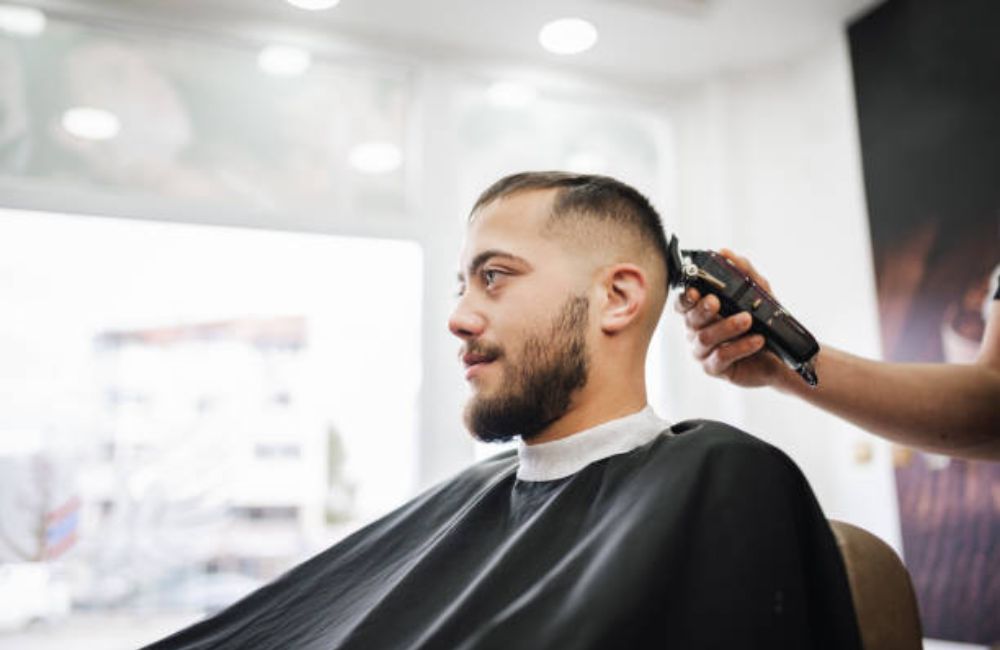
It is popular for practical reasons. It hides a receding corner and a high forehead, it needs almost no product, it grows out slowly because the fade is low, and it reads as neat in an office and relaxed on a weekend. Social video did the marketing; the cut did the rest. Compared with the mid taper fade, the low version keeps more hair on the side, which is why it suits a conservative dress code.
Who it suits: face shapes and hair types
It suits straight to wavy hair with medium or thick density, and it flatters round, oval, square and heart shaped faces. The forward fringe shortens the forehead, so it is at its best on a long face or a high hairline and at its weakest on a very short forehead.
Face shapes
- Oval and square: the fringe adds texture without changing the proportions.
- Round: keep the fringe a little longer at the front and add height with the dryer. For more height, our guide to the textured quiff sweeps the top up instead.
- Long or high forehead: the cut was made for you; the fringe covers the extra inch.
- Short forehead: ask for the fringe to sit higher and lighter, or choose a crop pushed up instead of down.
Hair types
Straight hair shows the taper line most cleanly and holds the choppy texture once it is cut in. Wavy hair gives the fringe natural movement with no product at all. Curly hair can wear it, but the fringe becomes a curly crop rather than a straight fringe. Fine hair works if the fringe stays short and the product stays matte. Gray or thinning hair has its own options in our guide to fades for men over 50.
How to ask for it
Say “low taper fade, skin at the sideburn and neck, leave the sides at a 2 or 3, textured fringe on top about an inch and a half, point cut.” That order covers every decision the barber has to make. Bring the screenshot too, but these numbers matter more than the photo.
- Level: low. The blend starts just above the ear and stays below the temple.
- Bottom: skin or a 0.5 guard at the sideburn and nape.
- Sides: a 2 (quarter inch) or a 3 (three eighths) above the blend.
- Top: one to two inches, point cut for texture, longer at the front than the crown.
- Fringe: worn forward, cut straight across or slightly uneven, sitting above the eyebrows.
- Neckline: natural or tapered, not blocked.
If you only know the look and not the numbers, say “low taper with a textured fringe” and answer the barber’s two questions: how much skin, and how long on top. Every level of the taper is described in our guide to the types of fade haircut.
How it is cut: the barber’s steps
The barber cuts the sides with clippers first and the top with scissors second, then connects the two. The top is where the time goes, because texture has to be cut in rather than styled in.
- Guard the sides at a 2 or 3 and clear everything below the parietal ridge.
- Set the bottom at skin or a 0.5 at the sideburn and nape, keeping it low.
- Open the blend with a 1 and a 1.5, lever open and closed, up to just above the ear. This is the taper.
- Section the top and cut the length with scissors over comb or over fingers, longer at the front.
- Point cut into the ends to remove weight and create the choppy texture.
- Cut the fringe straight across the forehead, then break it up with the points of the scissors so it does not look like a bowl.
- Connect the top to the sides with scissors over comb so there is no shelf.
- Detail the hairline and neckline, then the hot towel on the neck.
The point cutting in steps 5 and 6 is the whole difference between a textured fringe and a bowl cut. A barber who cuts the fringe blunt and stops has given you a different haircut. The scissor work on top is the same technique we use on our classic scissor cuts.
Styling it in two minutes, and the products
Towel dry, a fingertip of matte clay or paste, push the top forward with your fingers, done. If the fringe will not sit, a ten second blast from the dryer aimed forward sets it before the product goes in.
Clay gives a matte finish and a firm hold that keeps the pieces separated all day. Paste holds a little less and can be reworked at lunch. Sea salt spray on damp hair before either one adds grit to fine or very straight hair. Skip pomade and anything shiny; shine flattens texture and makes the fringe look thin and wet. The amount is a pea, warmed between the palms, applied from the back of the top forward so the fringe gets the least.
Mistakes that ruin it
The three mistakes we fix most are a fade taken too high, a fringe cut blunt with no texture, and too much product. Each turns this cut into a worse one.
- Too high a fade: a low taper that climbs to the temple is a mid fade, and the contrast fights the soft fringe.
- Blunt fringe: without point cutting the fringe sits in one piece and reads as a bowl cut.
- Fringe too long: below the eyebrows it hides your eyes in meetings. Keep it above the brow.
- Shiny product or too much of any product: the pieces clump and the top looks greasy by 10am.
- Cutting your own fringe: the line you cut in the mirror is never straight, and the fix is shorter than you wanted.
- Skipping the line up: a fuzzy sideburn on a low taper undoes the whole clean edge.
Trim schedule
Come back every 3 to 4 weeks for the full cut and every 2 weeks for a line up if you want the sideburn and neckline crisp in between. Because the taper is low, the grow out is gentle, and the fringe actually gets easier to style in week two as it gains a little weight.
| Visit | When | Time | Price |
|---|---|---|---|
| Full cut | Every 3 to 4 weeks | About 30 minutes | $35 |
| Line up and edge up | Around day 14 | About 15 minutes | $18 |
| Fringe only trim | If the fringe reaches the brow before the sides grow | About 10 minutes, ask in the chair | Part of the next cut |
Most of our clients on this cut spend $53 a month and look sharp for all of it.
Variations by hair type
The same order comes out differently on different hair, and that is a feature. The taper is identical; the fringe adapts to what the hair wants to do.
Straight
The cleanest version. The fringe sits flat and the texture shows as separate pieces. Ask for a little more point cutting so it does not look like a helmet.
Wavy
The fringe gets natural lift and movement. Let it dry with no dryer and the wave does the styling.
Thick
Ask for weight taken out of the top with thinning shears so the fringe does not sit heavy on the forehead.
Fine
Keep the fringe short and the top around an inch, use clay for the matte thickness, and skip the sea salt spray if it makes the hair feel dry.
Curly
The fringe becomes a curly crop, with the curls kept at about an inch and a half and shaped at the front rather than cut straight. Same low taper underneath.
Get the cut at Deja Vu Barbershop
The low taper fade with textured fringe is $35 at Deja Vu, cut by New York State licensed barbers, with the hot towel neck finish included. Add a beard for the Classic Combo at $48.
Deja Vu Barbershop is at 101 E 34th St between Park and Lexington in Murray Hill, two minutes from the 6 train at 33rd Street and about eight minutes on foot from Grand Central. Hours are Monday to Friday 8am to 7pm and Sunday 10am to 5pm, closed Saturday. Walk ins are always welcome, or book online. Call (212) 576-1062 with questions.
Questions readers ask
Is a low taper fade with textured fringe professional enough for an office?
Yes. The taper is low and the fringe sits above the brow, so it reads as a neat short cut in a suit. Keep the fringe out of your eyes and skip shiny product.
What guard is used for a low taper fade?
Usually skin or a 0.5 at the sideburn and nape, a 1 and 1.5 for the blend, and a 2 or 3 on the sides above it. Say the numbers and the barber will show you the guards first.
Can I get this cut with a receding hairline?
Yes, and it is one of the best cuts for it. The forward fringe covers the corners, and the low taper keeps attention off the hairline.
How long should the fringe be?
About an inch and a half at the front for most men, sitting above the eyebrows. Longer than the brow hides your eyes; shorter than an inch loses the texture.