Half the men who sit in our chairs ask for a taper when they mean a fade, or a fade when they mean a taper. Nobody gets hurt; the barber asks two follow up questions. But if you want to walk in, say four words and get exactly the cut in your head, it helps to know what those words mean to the person holding the clippers.
The short version: a taper is a gradual shortening around the sideburns and neckline that keeps some length everywhere, while a fade takes the sides down to very short or bare skin and blends up the head in a visible gradient. A taper is subtle and office safe by default. A fade is sharper, higher contrast and needs more upkeep. Both are $35 at Deja Vu, and both get the hot towel neck finish.
The one sentence difference
A taper shortens the hair gradually at the sideburns and the back of the neck and never goes to the skin, while a fade blends the sides from skin or near skin up into the top across a much bigger area of the head. Everything else is detail.
Think of it as how much of your head is involved. A taper touches maybe two inches of real estate: the sideburn and the neckline. A fade can touch everything below the parietal ridge, the shelf where the side of your head curves toward the top. That is why a fade reads as bold across a conference room and a taper reads as a man who got a tidy haircut.
The confusion comes from the word taper doing double duty as a verb (to taper the neckline) and a noun (a taper haircut), plus the taper fade, which is a third thing we will get to. One rule covers most cases: skin showing on the sides means fade. No skin showing means taper.
What a taper is: low, high, neckline and skin
A taper is a scissor and clipper cut that reduces length slowly toward the sideburn and the neckline, leaving the sides with visible hair the whole way down. On a classic taper you can still see hair at the bottom edge, just shorter than the hair above it.
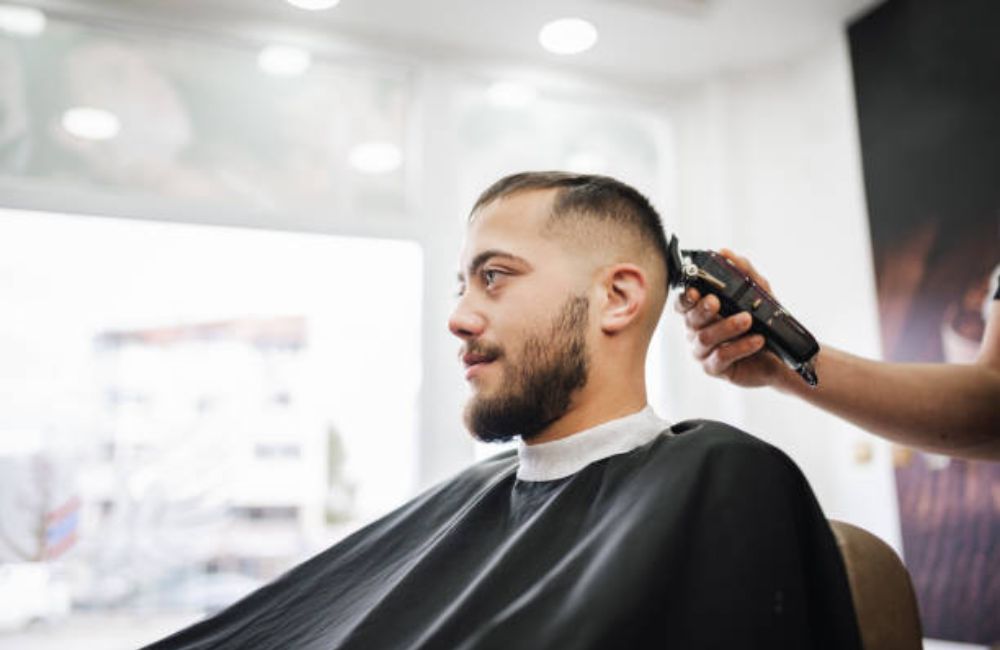
Low taper
The shortening starts about an inch above the ear and only at the sideburn and the nape. From the front, the sides look almost untouched. This is the cut most of our finance and law clients ask for because it reads as neat without announcing itself, and it is the easiest taper to grow out.
High taper
The gradient climbs two or three inches up the sideburn and nape, so there is more visible shortening. It is still a taper because the hair never disappears into skin. Men with thick hair that puffs out at the sides like it because it controls bulk without the maintenance of a fade.
Tapered neckline
This is a neckline treatment, not a whole haircut. Instead of a hard square or rounded line at the back, the barber blends the hair into the neck so there is no line, and it grows out invisibly. Most of our classic scissor cuts finish this way unless the client asks for a blocked neckline.
Skin taper
The very bottom of the sideburn and nape is taken to the skin, but only in that small zone. It is the one taper that shows skin, and it is where taper and fade overlap. Ask for a skin taper and get a low fade and you got the neighboring cut, not the wrong one.
What a fade is: low, mid, high, skin, drop and burst
A fade takes the sides and back down to a very short guard or bare skin and blends upward through two or three guard lengths until it meets the top. The name tells you where the shortest point sits.
Low fade
The blend starts just above the ear and stays low. It is the fade equivalent of the low taper and the one we recommend first to anyone nervous about going shorter. Our post on which fade haircut is right for you walks through the levels.
Mid fade
The blend starts at the temple and sits around the middle of the side. It is the most requested fade in the shop because it balances contrast and office manners.
High fade
The shortest point runs up to the parietal ridge, so almost the whole side is very short and the top sits like a shelf. High contrast, high upkeep, best on a strong jaw or a long face.
Skin fade
Any fade whose bottom is bare skin, done with a foil shaver or a straight razor. Low, mid and high skin fades all exist. The skin dictates the upkeep: about ten days before the bare zone looks like stubble.
Drop fade
The fade line drops behind the ear and follows the curve of the head toward the nape. It looks tailored on round heads and flatters a top that sweeps back.
Burst fade
A half circle of fade around the ear with a longer neckline, which is why it pairs with mohawks and curly tops. It is not an office cut in Midtown and we will tell you so, politely.
The taper fade: both at once, and the blend
A taper fade is a fade whose lowest point stays close to the sideburn and the neckline, so it has the gradient of a fade but the footprint of a taper. If you have ever seen a cut that looked like a fade from the side and a taper from the front, that was a taper fade.
The barber starts with a very short guard or bare blade at the bottom edge, like a fade, but keeps the whole gradient low and tight, like a taper. It hides a grow out better than a full fade and still gives you the sharp edge against the collar on a Monday morning.
Where the blend fits
Blend is the third word you will hear, and the least precise. A blend is the stretch between two lengths worked with clippers and a comb until no line shows. Every taper and every fade contains one. When a client asks for a blended cut, the barber usually hears a scissor cut with a soft taper, no skin, no visible step. A blend is a quality, not a style, so it never replaces the words taper or fade.
From softest to sharpest the ladder runs: blended scissor cut, low taper, high taper, taper fade, low fade, mid fade, high fade, skin fade. The most common office cuts in Murray Hill are the three in the middle.
Side by side: contrast, maintenance, grow out, office fit
The comparison in one place. Prices are our published prices and apply to every level of each cut.
| Factor | Taper | Fade | Taper fade |
|---|---|---|---|
| Shortest point | Short, never skin (except skin taper) | Skin or near skin | Skin or near skin, kept low |
| Area of the head involved | Sideburns and neckline only | Whole side and back | Sideburns, neckline, low on the side |
| Contrast with the top | Low | Medium to high | Medium |
| Weeks between cuts | 4 to 6 | 2 to 3 | 3 to 4 |
| Grow out | Invisible for weeks | Shows at 10 to 14 days | Shows at about 3 weeks |
| Office fit | Every office | Depends on level and dress code | Every office at low, most offices at mid |
| Time in the chair | About 30 minutes | About 30 minutes | About 30 minutes |
| Price at Deja Vu | $35 scissor cut | $35 fade | $35 fade |
The time row surprises people. A skin fade takes a few more passes with the foil shaver, but an experienced barber lands all three in the same half hour, which is why both carry the same $35 price on our price list. What changes is how many visits you need per year.
Which suits your face and hair
Choose by three things in this order: hair density, head shape, and how much contrast you can live with for the next two weeks. Face shape matters, but it matters less than the hair you were handed.
By hair type
Thick, straight hair that sticks out at the sides is a fade’s best friend; the fade takes the bulk away so the top can be styled without the sides fighting it. Fine or thinning hair does better with a taper or a low taper fade, because a high fade exposes scalp and makes the top look sparser than it is. Curly and coily hair wears either, and a fade’s gradient looks especially clean against tight curls.
By head and face shape
Round face: a mid or high fade adds height and narrows the sides. Long or oval face: keep it lower, a taper or low fade, so you do not stretch the face further. Square jaw: almost anything works, and a drop fade softens the corners. A flat back of the head looks rounder with a taper that leaves weight at the nape than with a fade that strips it.
By how bold you want to be
If you have never gone shorter than a scissor cut, start with a low taper fade. You get the edge, you keep the hair, and if you hate it, it is a scissor cut again in three weeks. Choosing for a child? Our guide to a kid’s first haircut covers that first visit.
Which reads best in a Midtown office
In the offices around Park and Lexington, a taper or a low taper fade passes every dress code we have heard of, a mid fade passes nearly all of them, and a high skin fade depends on your floor and your boss. That is the question our professional clients ask most.
Here is how we think about it after fifteen plus years cutting lawyers, bankers, consultants, nurses and the people who manage all of them. The office does not notice a haircut. It notices contrast. A gradient from skin to two inches of hair at the temple reads from across the room. A taper reads as neat. So the question is never taper or fade. It is how much contrast your workplace rewards.
Conservative floors: law, banking, client facing finance
Go with a classic taper or a low taper fade, no skin above the sideburn, and a tapered neckline so the grow out stays invisible. Keep the top long enough to comb, two to three inches. It looks right in a suit at 8am and at a client dinner at 8pm without touching it. If gray is part of the picture, our guide to natural looking gray blending covers the color side.
Business casual: tech, media, agencies
A mid fade or a mid taper fade is the sweet spot. You get the sharp line under the office lights, the top can carry texture or a side part, and nobody in a hoodie or a blazer will blink. Many clients in this bracket keep a beard too, which is why the Classic Combo (fade plus beard, $48) is our most used package.
Uniformed and healthcare
Short, clean and fast to maintain wins. A high taper or a low skin fade keeps hair off the collar and out of the cap. Add a $18 line up between cuts and the hairline stays crisp all month.
The dress down test
Whatever you choose should still look intentional on a Saturday in a tee. Tapers pass by nature. A high fade passes as long as the top is styled, which is the real cost of a fade: it looks great styled and slightly unfinished when it is not. If you will not put product in before work, choose the taper.
What to say in the chair, and how to keep it between visits
Tell the barber three things: the level (low, mid or high), the bottom (skin or a guard number), and what you want on top. That is the whole order. A reference photo helps, but these three words make it almost unnecessary.
The phrasebook
- “Low taper, scissor cut on top, tapered neckline.” The conservative office cut.
- “Low taper fade, number 2 up top on the sides, leave the top.” The grow out friendly middle ground.
- “Mid fade, skin at the bottom, blend to a 2, keep the length on top.” The most requested cut in the shop.
- “High skin fade, blend to a 1, tight on the sides, textured on top.” The bold one.
- “Just clean up the neckline and sideburns.” A taper, and a normal request.
Guard numbers run from 0 (bare blade) through 1 (an eighth of an inch) to 4 (half an inch). A 2 is a quarter inch and the most common side length in our fade haircuts.
The upkeep schedule
- Fade or skin fade: a fresh cut every 2 to 3 weeks at $35.
- Taper fade: a cut every 3 to 4 weeks at $35.
- Classic taper: a cut every 4 to 6 weeks at $35.
- Any of the above: a line up and edge up at $18 in the off week to reset the hairline, sideburns and neckline in about 15 minutes.
That last line keeps a fade affordable. A $18 line up in week two makes a $35 fade look new for another ten days, so a man on a mid fade can hold a three week cycle instead of a two week one and spend $53 instead of $70 over the same stretch.
Get the right one at Deja Vu Barbershop
Taper or fade, the price is $35, the chair time is about 30 minutes, and the hot towel neck finish is included. If you are still not sure, sit down and say “I work on a conservative floor” or “I want it sharp.” We will translate.
Deja Vu Barbershop is at 101 E 34th St between Park and Lexington in Murray Hill, two minutes from the 6 train at 33rd Street and about eight minutes from Grand Central. We are open Monday to Friday 8am to 7pm and Sunday 10am to 5pm, closed Saturday. Walk ins are always welcome, or book online and call (212) 576-1062 with questions.
Questions readers ask
Is a taper fade a taper or a fade?
It is a fade with a taper’s footprint. The bottom goes to skin or near skin like a fade, but the gradient stays low around the sideburns and neckline like a taper, so it grows out more gracefully than a full fade.
Which is cheaper over a year, a taper or a fade?
A taper, because you need fewer visits. At $35 a cut, a taper on a five week cycle costs about $365 a year while a fade every two to three weeks runs $600 to $900. A $18 line up in the off week lowers the fade number.
Will a fade look unprofessional in a law or banking office?
A low fade or low taper fade will not. Keep the skin only at the sideburn and nape, keep two to three inches on top, and the cut reads as neat rather than bold. Save the high skin fade for a less formal floor.
Can I switch from a fade to a taper without an awkward stage?
Yes. Let the fade grow for about three weeks, then ask for a low taper and a tapered neckline. The barber blends the old gradient into the new shape in one visit and nobody sees the transition.