Straight hair is the easiest hair to fade and the hardest hair to hide a bad fade on. Every line shows. Every missed guard step shows. That is good news if your barber is careful and bad news if he is in a hurry, and it is why the low taper fade, the gentlest fade on the menu, is the one we recommend first to men with straight hair.
A low taper fade on straight hair is a short blend that starts just above the ear, goes to skin or a very short guard only at the sideburn and neckline, and leaves the rest of the sides at a short, even length that straight hair lies flat against. It gives a crisp edge with low contrast, grows out over three to four weeks, and pairs with nearly any top from a crop to a slick back. It is $35 at Deja Vu, about 30 minutes, with a hot towel finish.
Why straight hair shows a taper line so cleanly
Straight hair lies flat and reflects light in one direction, so a gradient cut into it reads like a drawn line. On curly hair the texture scatters light and softens every transition; on straight hair there is nowhere for a mistake to hide. That is why a well cut low taper on straight hair looks almost printed on.
The same property decides what falls flat. Straight hair has no natural lift, so a top left too long with no texture cut into it collapses onto the forehead by lunch. And a high skin fade on fine straight hair exposes a lot of scalp against very flat hair above it, which can make the top look thinner than it is. The low taper avoids both problems: it keeps hair on the sides, keeps the contrast modest, and lets the scissor work on top supply the shape.
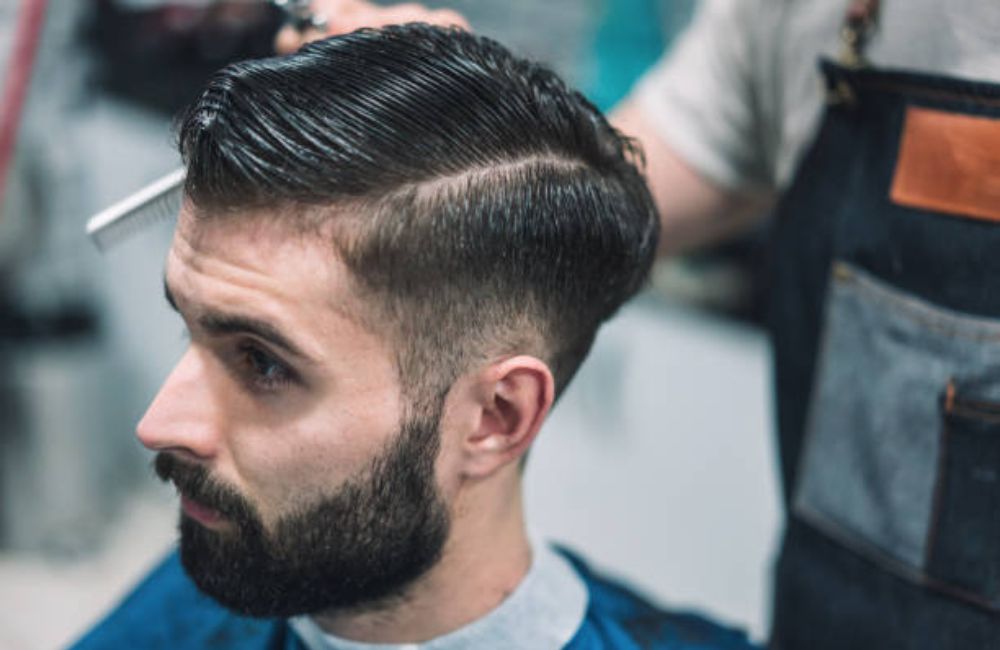
Density matters as much as texture. Thick straight hair pushes out at the sides, and the taper’s job is to take that weight down at the sideburn so the sides sit tight. Fine straight hair does not push out, so the taper’s job is only the edge. Tell the barber which one you have, or let him feel it; the guard choice changes. Our guide to fades on thick Asian hair goes deeper on density.
Low taper explained, and how it differs from mid, high and a regular fade
A low taper fade is a fade whose blend begins just above the ear and whose shortest point is confined to the sideburn and the neckline. Above the blend the sides keep one short length, usually a 2 or 3 guard, all the way up to the top.
- Low taper fade: blend starts just above the ear, stays below the temple. Lowest contrast, slowest grow out.
- Mid taper fade: blend starts at the temple. More contrast, two to three week grow out. Our post on the mid taper fade covers it.
- High taper fade: blend climbs toward the parietal ridge. Highest contrast of the tapers.
- Regular (full) fade: the whole side below a chosen height goes to skin or near skin, not just the sideburn and nape. A low fade and a low taper fade start at the same height, but the fade strips the side and the taper keeps it.
The technique is the same clipper and comb work in every case. What changes is how much of the head is involved. On straight hair, less involvement usually looks better, which is the whole argument for starting low. The full set of levels is on our fade haircuts page. For a conservative office, also see our guide to the subtle shadow fade.
Short, medium and long versions
The taper underneath is the same at every length. What changes is the top, and the top decides how much styling you sign up for. Straight hair holds a short top on its own, needs help at medium length, and needs a dryer and product at long length.
| Version | Top length | Sides | Styling time | Grow out | Best for |
|---|---|---|---|---|---|
| Short | Half inch to 1 inch (a 4 or 5 guard, or scissors) | 2 guard, skin at the edge | 0 to 30 seconds | 3 to 4 weeks | Thick hair, hot summers, zero fuss |
| Medium | 1.5 to 2.5 inches | 2 or 3 guard, skin at the edge | 1 to 2 minutes | 3 to 4 weeks | Textured crop, fringe, side part, most offices |
| Long | 3 to 5 inches | 3 guard, 0.5 at the edge | 5 minutes with a dryer | 4 to 5 weeks | Slick back, quiff, comb over, flow on top |
The medium version is the one we cut most on straight hair in Murray Hill. It has enough length for a part or a crop, it can be worn forward or to the side, and it still looks finished at the end of a twelve hour day. The long version is the executive look, and it is also the one that falls flat fastest if you skip the dryer.
The best tops for straight hair over a low taper
Five tops do most of the work on straight hair: the textured crop, the side part, the slick back, the fringe and the quiff. Each one solves a different problem that straight hair creates.
Textured crop
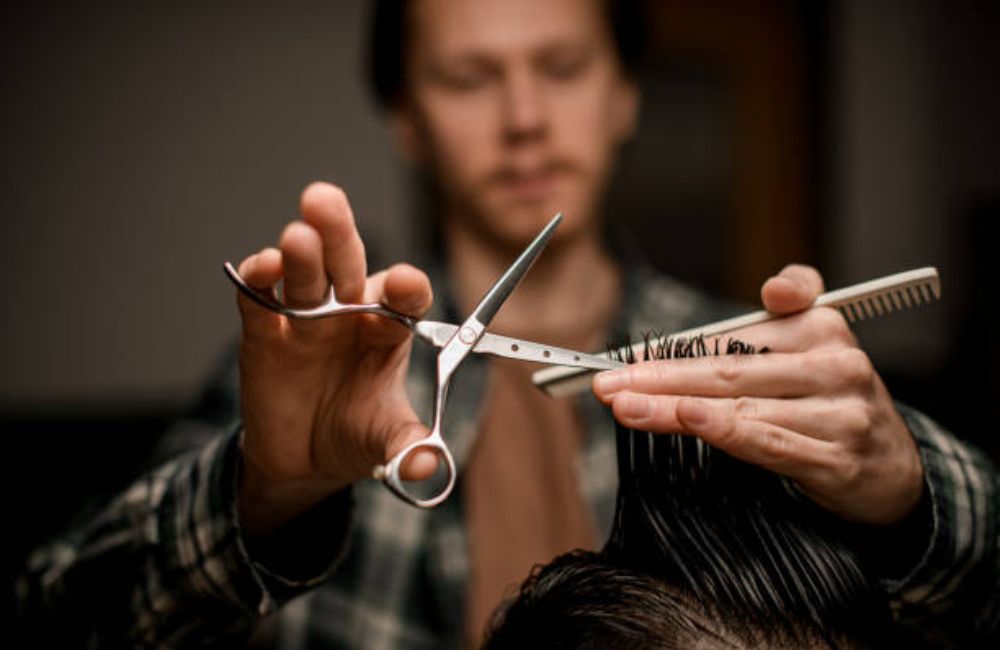
One to two inches, point cut for texture, pushed forward. Straight hair needs texture cut in because it will not make its own, and the crop is the cut built around that. It hides a receding corner and takes thirty seconds with clay. Our textured crop post goes deeper.
Side part
Two to three inches combed to one side with a natural or shaved part. Straight hair takes a part cleanly and holds it, which curly hair never does. The most conservative top on the list and the one that works with gray.
Slick back
Three inches or more combed straight back with a water based pomade. The classic businessman top, and the one that needs the most product because straight hair wants to fall forward.
Fringe
Front longer than the crown, worn down over the forehead. Textured or blunt. The low taper fade with textured fringe is the version everyone is asking for right now.
Quiff
Two to four inches swept up and back at the front. Straight hair needs a blow dryer and sea salt spray to get the lift, but once it is up it stays up all day with a clay on top.
What falls flat: a long, blunt top with no texture and no product. Straight hair cut to one length on top with nothing done to it sits like a cap. Ask for point cutting or thinning on anything over two inches.
Face shape guide
The low taper flatters every face because it does not exaggerate anything; the top is where face shape matters. Pick the top for the face, let the taper stay low, and you are most of the way there.
- Oval: any top. The side part and the crop both look tailored.
- Round: add height with a quiff or a crop styled up. Avoid a flat fringe that widens the face.
- Square: side part or slick back. The clean sides and the strong jaw agree with each other.
- Long: textured crop or fringe to shorten the forehead. Skip the tall quiff.
- Heart: fringe or a soft crop to balance a narrower chin, with the sides kept at a 3 for a little width.
- Receding hairline: crop or fringe worn forward. Avoid a slick back, which exposes the corners.
If you are not sure which shape you are, the barber will tell you in the first ten seconds and suggest the top accordingly. It is the most common question we get and the fastest to answer in person.
Styling at home and the products for straight hair
Straight hair needs two things from a product: grip and a matte finish. Clay and paste give both. Pomade gives shine and control for a slick back or side part. Sea salt spray on damp hair gives the lift that straight hair lacks on its own. That is the whole shopping list.
The routine by length
- Towel dry to damp. Product on wet straight hair slides off; product on dry straight hair clumps.
- Short top: a pea of clay, rubbed between the palms, pushed through with the fingertips. Done.
- Medium top, crop or fringe: optional ten seconds of dryer aimed forward, then clay or paste, then shape with the fingers.
- Medium top, side part: a fingertip of pomade or cream combed through, part with the comb, comb the direction. Finish with a dry comb for a clean edge.
- Long top, slick back: pomade combed through from front to back while damp, then a second light pass once dry.
- Long top, quiff: sea salt spray on damp hair, blow dry up and back with a vent brush, clay through the length, shape the front with your fingers.
- Brush the sides down with a soft brush and wipe whatever is left on your hands through them.
Which product
| Product | Finish | Hold | Best for |
|---|---|---|---|
| Clay | Matte | Strong | Crop, short quiff, fine or thick straight hair |
| Paste | Low shine | Medium, reworkable | Textured medium tops |
| Water based pomade | Shine | Medium to strong | Side part, slick back, comb over |
| Styling cream | Natural | Light | Longer tops, soft side part, men who hate stiff hair |
| Sea salt spray | Matte | Light pre styler | Lift on fine or flat straight hair before any of the above |
Fine straight hair should stay matte; shine makes it look thinner. Thick straight hair can take pomade. And half the amount you think you need is correct on straight hair every time, because excess has nowhere to hide.
Mistakes that make a low taper fall flat
Most bad low tapers on straight hair come from one of six mistakes, and four of them happen at home rather than in the chair.
- Taper taken too high: once the blend reaches the temple it is a mid taper, and on straight hair the extra contrast can look harsh with a short top.
- Blend with visible steps: straight hair shows every guard line. If you can see where the 1 became the 2, ask the barber to open it up before you leave the chair.
- Top left blunt and heavy: straight hair needs texture cut in. A blunt top over a clean taper looks like a cap on a clean neck.
- Shiny product on fine hair: it separates into strands and shows scalp.
- Too much product: straight hair holds a pea; a fingertip is a grease slick by 11am.
- Self trimming the neckline: the line you cut in the mirror slopes, and a sloped neckline on straight hair is visible from across the room. A $18 line up fixes it in 15 minutes.
How to ask your barber, and the upkeep
Say “low taper fade, skin at the sideburn and neck, 2 on the sides, and” then the top from the list above with a length in inches. Add “keep it low” if you have been given a mid fade before when you asked for a taper. That is the whole order.
Phrasebook for straight hair
- “Low taper, skin at the edges, 2 on the sides, textured crop about an inch and a half.”
- “Low taper, half guard at the edges instead of skin, side part on top, natural neckline.”
- “Low taper, 3 on the sides, leave the top long for a slick back, take some weight out.”
- “Same as last time, a little shorter on top.”
Upkeep schedule
- Day 0: the full low taper fade, $35, about 30 minutes.
- Day 14: a line up and edge up, $18, about 15 minutes, to reset the sideburn, hairline and neckline.
- Day 21 to 28: the full cut again. Straight hair grows out evenly, so the taper softens rather than going blotchy, and most men can hold four weeks.
- Every two or three days: wash, towel dry, brush the sides down. Daily washing dries the scalp and shows against short sides.
That is $53 a month on a three week cycle or $35 on a four week one. The top may need a trim between taper visits if you wear it long; ask for a dusting of the ends when you come in for the line up. It is the same scissor work as our classic scissor cuts.
Get a low taper fade at Deja Vu Barbershop
A low taper fade is $35 at Deja Vu, cut by New York State licensed barbers with 15 plus years of experience on the team, and every haircut ends with a hot towel on the neck. Add a beard trim for the Classic Combo at $48.
Deja Vu Barbershop is at 101 E 34th St between Park and Lexington in Murray Hill, two minutes from the 6 train at 33rd Street and about eight minutes from Grand Central. Hours are Monday to Friday 8am to 7pm and Sunday 10am to 5pm, closed Saturday. Walk ins are always welcome, or book online. Call (212) 576-1062 with questions.
Questions readers ask
Does a low taper fade work on thin straight hair?
Yes, better than most fades, because the sides keep a short length instead of going bare. Pair it with a textured crop and a matte clay and the top reads fuller.
Should I get skin or a guard at the bottom of a low taper on straight hair?
Skin gives the sharpest edge and shows stubble after about ten days. A 0.5 guard looks almost as clean and grows out with no stubble stage. If you work in a conservative office, start with the half guard.
How long should the top be for a low taper fade on straight hair?
One to two inches for a crop or fringe, two to three for a side part, three or more for a slick back or quiff. Anything over two inches needs texture cut in or it will sit flat.
Can I get a low taper fade and keep my hair long on top?
Yes. The taper only touches the sideburns and neckline, so the top can stay at three to five inches for a slick back, quiff or flow. Ask for the sides at a 3 so the transition stays soft.