A straight razor is a single edge of steel, a handle, and no safety bar between the blade and your skin. It is also the closest shave there is, which is why every hot towel shave at Deja Vu still ends with one and not a cartridge. The question is whether you should be holding it yourself.
You can shave with a straight razor at home if you learn four things in order: how to strop the blade, how to prepare the skin with heat and lather, how to hold the razor at about a 30 degree angle, and how to shave each part of the face with the grain before you ever try against it. It takes a few weeks of slow shaves to get good. Or it takes about 30 minutes and $35 to sit in a chair and let a licensed barber do it while you keep your hands warm under a towel.
Why barbers still use a straight razor
Because nothing else shaves as close, and nothing else lets the barber see and control exactly where the edge is. A cartridge drags three to five blades across the skin and hopes. A straight razor is one blade, held at a chosen angle, moving in a chosen direction, and the barber can feel the stubble come off through the handle.
There are practical reasons too. A straight razor lines up a beard, a neckline and a sideburn cleaner than any trimmer. It is sanitized between clients, with a fresh blade in a shavette or a stropped edge on a fixed blade, which is more than most men can say about the cartridge in their shower. And the ritual matters: warm towels, a brush, lather, and a barber’s full attention is a half hour that a $35 bill buys outright at the hot towel shave.
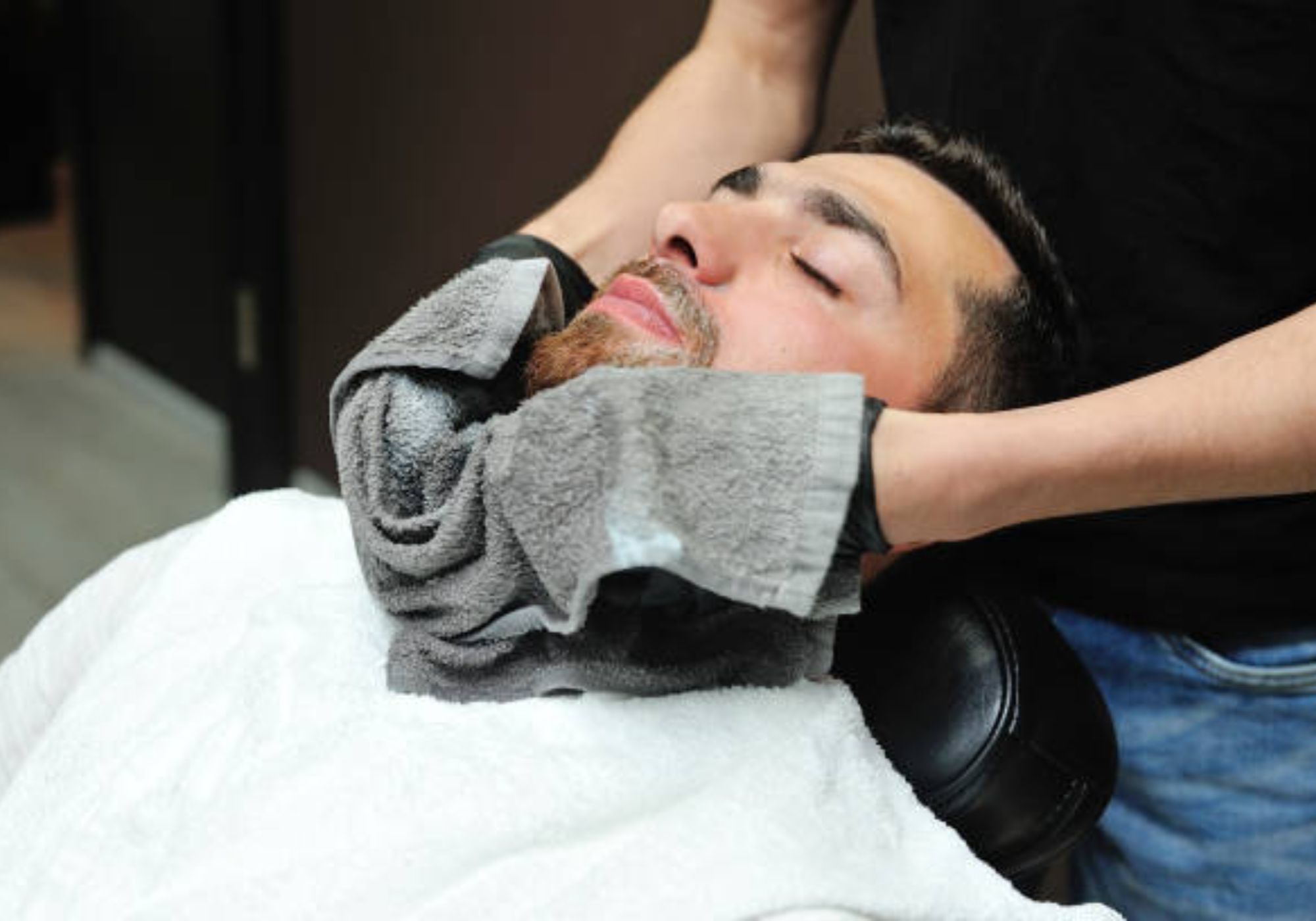
The honest trade is this. The barber has done thousands of these. You have done zero. The straight razor rewards the first man and punishes the second, which is why the rest of this post is slow and specific.
What gear you need
A razor, a strop, a brush and a soap or cream. That is the kit. Everything else is a nice to have, and the hone is a later purchase.
- The razor. A fixed blade straight razor, five eighths of an inch wide is the common beginner size, with a round point rather than a square one. Square points nick. Or a shavette, which takes disposable half blades and skips the stropping and honing entirely. Shavettes are less forgiving on the skin but cheaper and simpler to maintain.
- The strop. A leather strop, often with a canvas side. You use it before every shave on a fixed blade. Not needed for a shavette.
- The brush and soap. A shaving brush, badger or synthetic, and a hard soap or a cream that whips into a thick lather. Canned foam does not lift the hair the way a brushed lather does.
- A hone. A fine sharpening stone, something in the 8000 grit range, for every few months of use. Beginners should not hone; buy the razor shave ready and strop until it dulls.
- Aftershave balm. Alcohol free, for after. Our post on what aftershave does explains why balm and not splash.
Buy the best razor you can afford once rather than a cheap one twice. A dull or badly ground edge is the main reason beginners cut themselves and quit.
Stropping: the step beginners skip
Strop before every shave, twenty to thirty laps on the leather, and the blade stays shave ready for months. Skip it and the edge folds over microscopically within a few shaves, which feels like the razor pulling and ends with a nick.
- Hang the strop from a hook and pull it taut with your free hand.
- Lay the razor flat on the leather, spine and edge both touching, with the edge facing away from the direction of travel.
- Push the razor along the strop spine first, edge trailing. At the end, roll it over on its spine, never on its edge, and bring it back the same way.
- Keep the pressure light. The weight of the razor is enough.
- Twenty to thirty laps on leather. If the strop has a canvas side, ten laps on canvas first.
Keep the strop clean and flat, and rub a drop of oil into the leather every few months. Lifting the spine off the strop while moving, even slightly, rolls the edge and undoes the work. Every barber learned this the hard way once.
Prepare the face: heat, then lather
Soften the hair before the blade touches it. Whiskers absorb warm water and get easier to cut; a hot towel does this better than anything, which is the entire reason it is in the name of the service.
At home, shave after a hot shower, or hold a towel soaked in hot water against the face for two to three minutes. Then lather. Load the brush on the soap, build a thick lather in a bowl or on the face, and work it in with circular strokes for a full minute. The brush lifts the hair and the lather holds water against it. Thin, foamy lather from a can does neither; it is the second most common reason beginners get razor burn, after a dull blade.
Finally, map your grain. Run a dry hand over the face and note which way the stubble resists. Most men grow down on the cheeks, in every direction on the chin, and up or sideways on the neck. Your first pass goes with that grain, everywhere.
How to hold a straight razor
Thumb on the underside of the shank near the pivot, first three fingers on top of the shank, little finger on the tang at the end. The scales, the handle, swing up and out of the way between the little finger and the ring finger. That is the standard grip, and it keeps the blade stable without squeezing.
The angle is the whole technique. Hold the blade at about 30 degrees to the skin. Flatter than that and it skids over the hair; steeper and it scrapes the skin. A useful way to find it: lay the razor flat on your cheek, spine touching, then lift the spine until the gap under it is about the thickness of the spine itself. That is roughly 30 degrees. Keep the angle the same for the whole stroke.
Pressure: almost none. A sharp straight razor cuts hair by being sharp, not by being pushed. If you feel the need to press, strop. And always, with the free hand, pull the skin taut above the stroke. Flat skin is safe skin; a loose fold is where a nick happens.
The shave, region by region
With the grain, everywhere, in short strokes of an inch or two, rinsing the blade after each. The whole first pass takes most beginners ten to fifteen minutes. A second pass across the grain comes after a few weeks. Against the grain is for experienced hands, and plenty of barbers never bother with it on a client with sensitive skin.
| Region | Usual grain | Skin stretch | Strokes | Watch for |
|---|---|---|---|---|
| Cheeks | Downward | Pull up at the cheekbone | Short, downward, from sideburn to jaw | Easiest area; start here |
| Upper lip | Downward | Curl the lip over the teeth | Very short, straight down | The point of the razor near the nose |
| Chin | Mixed | Pull the lower lip down or the jaw sideways | Short strokes following the curve | Changing angle over the curve |
| Jawline | Downward to sideways | Tilt the head away | Follow the bone | The corner of the jaw |
| Under the chin and neck | Upward or sideways | Tilt the head back, stretch with the free hand | Short, with the grain, often upward | Most nicks happen here |
Cheeks
Start on the right cheek if you are right handed, razor in the right hand, left hand stretching the skin up from the cheekbone. Short downward strokes, sideburn to jaw. Switch hands for the left cheek if you can; if not, reach across carefully and keep the angle.
Upper lip
Curl the lip in over the teeth to flatten it. Straight down, very short strokes, and mind the point of the razor where it passes under the nostril. This is the region where a round point earns its keep.
Chin
The hair changes direction across the chin, so map it beforehand. Stretch the skin by pulling the lower lip down or the jaw to the side, and take short strokes that follow the curve, adjusting the angle as the blade goes over the point of the chin.
Under the chin and the neck
Tilt the head back, stretch the skin with the free hand, and go with the grain, which on most necks means upward or sideways strokes. This is where beginners get hurt, because the skin is loose and the grain is backwards from the cheeks. Slow down here, or stop the first few shaves at the jawline and finish the neck with your usual razor until the hands know the job. Our guide to preventing razor bumps covers why the neck grain matters so much.
Safety, nicks and aftercare
Most cuts come from one of four things: a dull edge, a wrong angle, loose skin, or going against the grain too soon. Fix those and a straight razor is safer than it looks, because the blade never touches the skin unless you tilt it in.
When you nick yourself, and you will, cold water and a styptic pencil or a dab of alum stop it in a minute. Never shave in a hurry, never shave a face you have not lathered, and never try to catch a falling razor. Close it and put it down between regions.
After the last pass, rinse with cool water to take the heat down, pat dry, and apply an alcohol free balm. The cool rinse and the balm are what the hot towel shave does at the end for a reason: the skin has just been scraped, and it wants moisture, not a splash of alcohol. If bumps show up anyway, our guide to calming razor bumps by morning has the routine. Let the razor dry completely before closing it, and strop it before the next shave, not after this one.
Tips for the first month
Go slow, go with the grain, and keep your old razor nearby. The point of the first month is to finish with a face, not a close shave.
- Shave on a weekend morning, not a work day. Give yourself 30 minutes with no meeting after it.
- Do the cheeks only for the first three or four shaves and finish the rest with your usual razor. Add the chin, then the lip, then the neck.
- One pass, with the grain, for at least two weeks. Then a second pass across the grain. Against the grain is a month away, if ever.
- Strop every time. Lather properly every time. The shave is only as good as the two steps before it.
- If the razor pulls, stop. It is dull, the angle is wrong, or the lather is thin. Pushing through is how a nick becomes a cut.
And one practical shortcut: get a professional shave first and watch. Thirty minutes in the chair shows you the angle, the stretch and the stroke length better than any video, and the $35 includes the towels.
Or sit down and let us do it, at Deja Vu Barbershop
Deja Vu Barbershop is at 101 E 34th St between Park and Lexington in Murray Hill, two minutes from the 6 train at 33rd Street and about eight from Grand Central. Every barber is New York State licensed, every razor and workstation is sanitized between clients, and the straight razor is a daily tool here, not a novelty. A hot towel shave is $35 and about 30 minutes: warm towels, brushed lather, the straight razor, aftershave balm. The Royal Shave is $50 and about 45 minutes with extended hot towel steps, and the Royal Treatment pairs it with a beard trim for $60.
Hours are Monday to Friday 8am to 7pm and Sunday 10am to 5pm, closed Saturday. Walk ins are always welcome, or book online. Call (212) 576-1062 with any question before you come in.
Questions readers ask
What angle do you hold a straight razor at?
About 30 degrees to the skin. Lay the razor flat, then lift the spine until the gap under it is about the thickness of the spine. Flatter skids; steeper scrapes.
Is a shavette easier than a real straight razor?
Easier to maintain, since there is no stropping or honing, and the blade is always sharp. It is less forgiving on the skin because the blade is thinner and stiffer, so the angle has to be more exact.
How often do you strop a straight razor?
Before every shave, twenty to thirty light laps on leather. Honing on a fine stone is every few months and is best left to someone who has done it before.
Should a beginner shave against the grain?
Not for the first month. One pass with the grain for two weeks, then a pass across the grain. Against the grain is where most razor burn and ingrown hairs come from, and many barbers skip it on sensitive skin.
Does a barber’s straight razor shave hurt?
No. With a hot towel, proper lather and a stropped blade, it is the smoothest shave most men have had. The hot towel shave at Deja Vu is $35 and about 30 minutes.