Every month someone in the chair asks whether the oil he bought is making his beard grow. He wants a yes. We like our clients, so we give them the truth instead. Beard oil is a good product that does several useful things, and growing new hair out of skin that was not going to grow it is not one of them.
The direct answer: there is no solid evidence that beard oil makes a beard grow faster, thicker or in places where it was not already growing. What beard oil does is condition the skin and soften the hair you have, which cuts itch, flakes and breakage. A beard that breaks less and lies better looks fuller within a few weeks, and that is where the growth stories come from. Genetics, hormones and time decide the rest, and a good beard trim decides how what you have looks.
The short answer: oil helps the beard you have, not the beard you want
No oil sold as a grooming product has been shown to grow new beard hair in men. The products labeled growth oil are, with rare exceptions, the same carrier oils as any beard oil with a stronger claim on the bottle.
That is not a knock on beard oil. It is one of the few grooming products that does exactly what it says when the label is honest: it conditions the skin under the beard, softens the hair, and makes the beard easier to comb and shape. Those things make a beard look better fast. They just are not growth, and knowing the difference saves you money and three months of waiting for a patch to fill in that was never going to. If you have a bottle, use it. If you are shopping for growth, the sections below will tell you what actually moves that needle and what does not.
What actually decides how your beard grows
Genetics first, hormones second, age third, and general health a distant fourth. Nothing you rub on the outside of your face changes the first two, and the third takes care of itself.
Beard hair is driven by androgens, the male hormones, and by how sensitive the follicles on your face are to them. That sensitivity is inherited. Two men with the same hormone levels can have completely different beards because their follicles respond differently. This is why your father’s beard is a better predictor than any product. Age matters because many men keep filling in through their twenties and some into their early thirties, so a patchy beard at 22 is often a full beard at 28 with no help at all. Published research also links sleep, nutrition and stress to hair quality generally, and we believe it, but the effect is on how healthy the existing hair is, not on where it grows.
Hair grows from the follicle at roughly half an inch a month on average, with wide variation between men. Oil on the skin does not reach the part of the follicle that controls that rate. Anyone promising to speed it up from the outside is selling the hope, not the mechanism.
What beard oil really does
Beard oil moisturizes the skin under the beard, softens the hair, reduces itch and flaking, and makes the beard easier to comb without breaking it. That is the full list, and it is a good list.
The skin under a beard dries out because the hair wicks away the skin’s own oil and because washing removes the rest. Dry skin itches, and itching is the number one reason men shave off a beard in the first month. A few drops of oil massaged down to the skin stops that. The same oil coats the hair, which makes it less wiry and less likely to snap when you comb it or pull a sweater over your head. Less breakage means more of the hair you grow stays on your face, and a beard that lies flat looks denser than one that sticks out in every direction. Add a scent and a slight shine and the beard looks cared for, which reads as fuller to everyone who sees it.
Why oil looks like it works
Men who start using oil often swear the beard grew. It did, because beards grow. The oil just made the growth visible by keeping the hair on the face and lying in the right direction.
Three things happen at once when a man starts a routine. First, he stops scratching, so he stops pulling hairs out and stops irritating follicles. Second, the hair stops breaking at the ends, so the beard reaches a length it never reached before. Third, he usually starts combing and trimming more carefully, because he is paying attention, and a shaped beard looks fuller than a wild one. Put those together over six weeks and the beard in the mirror looks like a different beard. None of it came from new follicles switching on. The honest way to say it is that oil helps you keep what you grow, and keeping it is most of the game.
What the research says about growth oils and ingredients
The evidence for any topical oil growing beard hair in men is thin. Most claims trace back to small studies, animal studies, or studies on scalp hair, and none of those is the same as a trial on men’s faces.
One often cited study on a particular essential oil was done on mice, and the results in mice have not been reproduced in men. Other ingredients common in growth oils have published research showing they moisturize or reduce inflammation, which is useful, but moisturizing is not growing. If a product claims a specific percentage of new growth in a set number of weeks, ask where the trial is. Usually there is not one. The one category with real evidence behind it for hair growth is medication, and that is a conversation for a dermatologist, who can tell you whether anything is appropriate for the face, what the side effects are, and whether your patchiness is something treatment would help at all. A barber should not be the one prescribing it, and we are not.
Side effects and risks worth knowing
Beard oil is low risk for most men. The problems that do come up are skin reactions, clogged pores and, with some scented oils, irritation on sensitive skin.
Essential oils are the usual cause of reactions. They smell good and some men’s skin hates them. If a new oil makes the skin red, hot or itchy within a day, stop, wash it off and try an unscented one. Patch test anything new on the inside of the forearm for a day before it goes on the face. Heavy oils can clog pores on men prone to breakouts, especially along the jaw and neck where sweat collects under a collar. Use fewer drops and wash the beard more often if that happens. Bumps from shaving are a different problem, covered in our guide to calming razor bumps overnight. Oil on the pillow stains, so apply it in the morning or give it twenty minutes before bed. And keep oil away from the eyes, which sounds obvious until you rub your face in a meeting. If a reaction does not settle within a few days of stopping, or if you have bumps that spread, see a dermatologist rather than switching bottles.
What does help a beard look fuller
Time, patience, a good trim, and not sabotaging the hair you already have. That list is less exciting than a bottle, and it works.
Give it twelve weeks
Most men judge a beard at three weeks and quit. Patches that look hopeless at three weeks often close at eight, because hair grows at different rates on different parts of the face and the long hairs eventually cover the slow spots. Twelve weeks untouched is the fair test. Oil and a comb make those twelve weeks tolerable.
Stop over trimming
Trimming the beard short to tidy the patches resets the clock every time. Let it grow, keep only the neckline and cheek line clean, and let the barber decide what to shape. Our guide on where to shave your beard on the neck shows where that line goes.
Let the shape do the work
A beard trimmed to the face looks fuller than a longer beard that was left alone. Shorter sides and a longer chin on a round face, a tighter chin on a long face, and clean lines everywhere make a thin beard read as intentional. The method is in how to shape a beard to your face shape.
Use the products in the right order
Oil first, to the skin. Balm second, to the hair, if the beard needs hold. The steps and amounts are in how to use beard balm vs beard oil.
Sleep, eat and leave it alone
Hair is built from what you eat and repaired while you sleep. Neither will grow follicles you do not have, but both keep the ones you do have producing decent hair. And keep your hands off it. Twisting, pulling and scratching cost more hair than anything else on this list.
What the barber can do for a thin or patchy beard
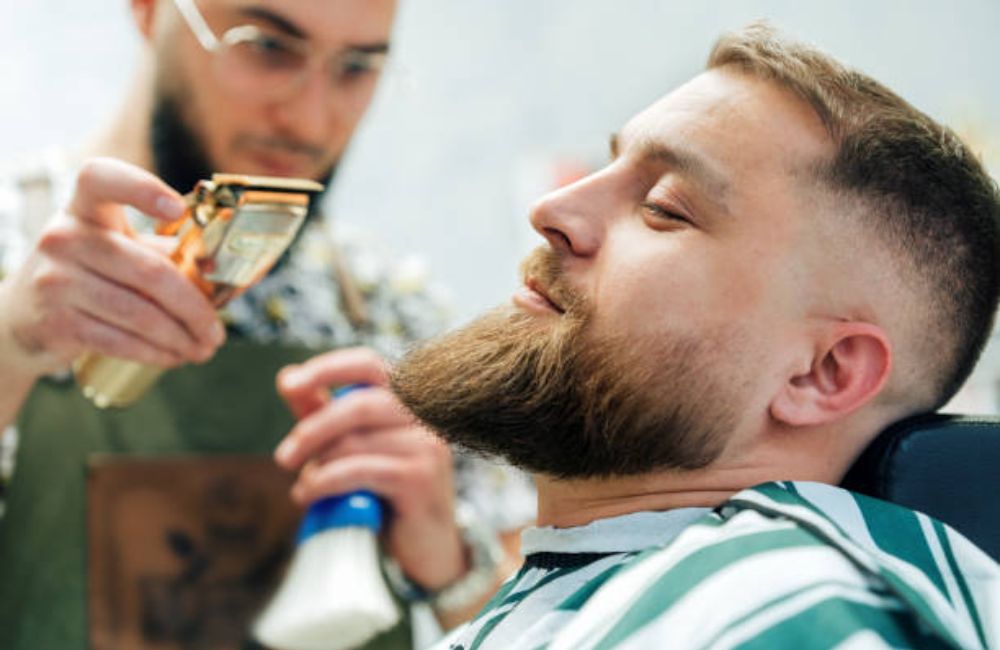
A barber cannot grow hair either, and any barber who says otherwise is selling product. What a barber can do is shape what is there so the patches are least visible, set the lines so the beard looks deliberate, and tell you honestly whether the beard you want is one your face can grow.
At Deja Vu a beard trim and grooming is $18. The barber sets a length that evens out the density, which usually means shorter on the thin areas and slightly longer where the beard is strong, then cleans the cheek line and the neckline with a straight razor and finishes with a hot towel. A line up and edge up is $18 for the lines alone. The Sharp Edge package pairs a line up with the beard for $30. Men growing a beard for the first time do well with a visit at about week four to set the lines, then again at week eight or twelve to shape the length once it has filled in. The home routine between visits is in how to keep your beard sharp between barber visits.
| Week | What to do at home | Shop visit | Price |
|---|---|---|---|
| Weeks 1 to 4 | Oil daily, no trimming, comb once a day | None, or a line up for the hairline | $18 |
| Week 4 | Keep the oil, add balm if the hair sticks out | Beard trim to set the cheek line and neckline | $18 |
| Weeks 5 to 8 | Oil, balm, shave below the neckline every 3 to 5 days | Sharp Edge, line up plus beard, at week 6 if the lines drift | $30 |
| Week 8 to 12 | Judge the beard honestly, with the barber’s input | Beard trim to shape the length, or Classic Combo with a fade | $18 or $48 |
| Ongoing | Oil daily, balm as needed | Beard trim every 2 to 4 weeks | $18 |
When to see a dermatologist instead
A patchy beard is usually genetics, and genetics is not a medical problem. A beard that was full and is now losing hair in round spots, or skin under the beard that is red, scaly or painful, is a different matter and deserves a doctor.
Sudden round bald patches in the beard can be a form of alopecia that a dermatologist can diagnose and often treat. Persistent flaking that oil does not fix can be a skin condition rather than dryness. Bumps that keep coming back along the neck may be ingrown hairs or something that needs a prescription. None of those are things a bottle of oil or a barber should be handling. We will keep the beard shaped around whatever is going on, and we will tell you plainly when what we are seeing looks like a question for a dermatologist.
Get a beard that looks full at Deja Vu Barbershop
Grow it for twelve weeks, oil it every morning, and let a licensed barber shape what comes in. Deja Vu Barbershop is at 101 E 34th St between Park and Lexington in Murray Hill, two minutes from the 6 train at 33rd Street and about eight minutes from Grand Central. Hours are Monday to Friday 8am to 7pm and Sunday 10am to 5pm, closed Saturday.
Walk ins are always welcome, or book online. Call (212) 576-1062 with questions. A beard trim is $18, and the honest opinion is free.
Questions readers ask
Does beard oil help a patchy beard fill in?
Not directly. It keeps the hair you have softer and less likely to break, which can make patches less obvious, but it does not create new hair. Time and a shaped trim do more for patches than any oil.
How long until beard oil shows results?
The skin usually feels better within a few days and the beard feels softer within a week or two. Any change in how full it looks takes four to six weeks and comes from less breakage, not new growth.
Can beard oil cause hair loss?
Oil itself does not. A reaction to a scented oil can irritate the follicles, and scratching an irritated beard pulls hair out. If a product makes the skin red or itchy, stop and switch to an unscented one.
Is growth oil different from regular beard oil?
Usually not by much. Most growth oils are standard carrier oils with an added ingredient and a bigger claim. Read the ingredients, ignore the promise, and ask a dermatologist about anything that claims medical effects.